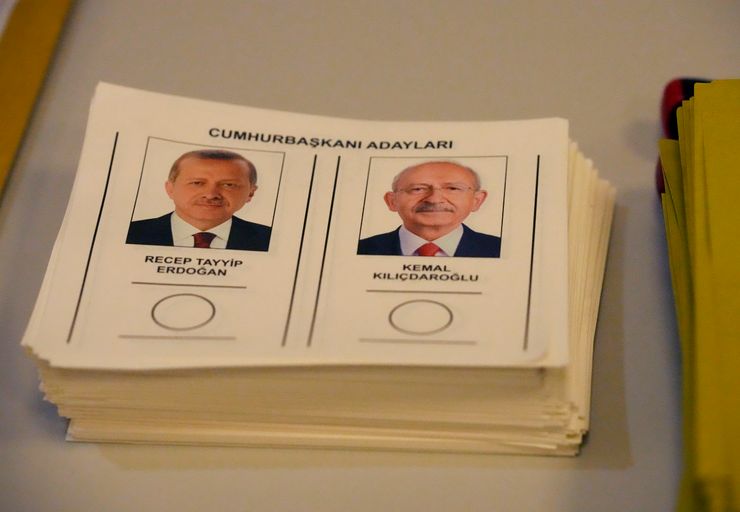
Voters in Turkey choose between Erdogan and Kilicdaroglu in presidential runoff
May 28, 2023

Voters in Turkey returned to the polls to decide whether the country’s longtime leader stretches his increasingly authoritarian rule into a third decade or is unseated by a challenger who has promised to restore a more democratic society

ANKARA, Turkey (AP) — Voters in Turkey returned to the polls Sunday to decide whether the country’s longtime leader stretches his increasingly authoritarian rule into a third decade, or is unseated by a challenger who has

promised to restore a more democratic society

.

President Recep Tayyip Erdogan, who has been at Turkey’s helm for 20 years, is

favored to win

a new five-year term in the second-round runoff, after coming just short of outright victory in the first round on May 14.

The divisive populist

finished four percentage points

ahead of Kemal Kilicdaroglu, the candidate of a six-party alliance and leader of Turkey’s center-left main opposition party. Erdogan’s performance came despite crippling inflation and the effects of a devastating earthquake three months ago.

The final decision could have implications far beyond Ankara. Turkey stands at the crossroads of Europe and Asia, and it plays a key role in NATO.

Erdogan's government vetoed Sweden’s bid to join NATO and purchased Russian missile-defense systems, which prompted the United States to oust Turkey from a U.S.-led fighter-jet project. But it also helped broker a crucial deal that allowed Ukrainian grain shipments and averted a global food crisis.

The two candidates offered sharply different visions of the

country's future

, and its recent past.

“This election took place under very difficult circumstances, there was all sorts of slander and defamation,” the 74-year-old Kilicdaroglu (pronounced KEH-lich-DAHR-OH-loo) told reporters after casting his ballot. “But I trust in the common sense of the people. Democracy will come, freedom will come, people will be able to wander the streets and freely criticize politicians.”

Speaking to reporters after casting his vote at a school in Istanbul, Erdogan noted that it’s the first presidential runoff election in Turkey’s history. He also praised high voter turnout in the first round and said he expected participation to be high again on Sunday. He voted at the same time as Kilicdaroglu, as local television showed the rivals casting ballots on split screens.

“I pray to God, that it (the election) will be beneficial for our country and nation,” he said.

More than 64 million people are eligible to cast ballots. The polls opened at 8 a.m.

Turkey does not have exit polls, but preliminary results are expected to come within hours of the polls closing at 5 p.m.

Critics blame Erdogan’s unconventional economic policies for skyrocketing inflation that has fueled a cost-of-living crisis. Many also faulted his government for a slow response to the earthquake that

killed more than 50,000

people in Turkey.

In the mainly Kurdish-populated province of Diyarbakir — one of 11 regions that was hit by the Feb. 6 earthquake — 60-year-old retiree Mustafa Yesil said he voted for “change.”

“I'm not happy at all with the way this country is going. Let me be clear, if this current administration continues, I don’t see good things for the future,” he said. “I see that it will end badly — this administration has to change.”

Mehmet Yurttas, an Erdogan supporter, disagreed.

“I believe that our homeland is at the peak, in a very good condition,” the 57-year-old shop owner said. “Our country’s trajectory is very good and it will continue being good.”

Erdogan has retained the backing of conservative voters who remain devoted to him for lifting Islam’s profile in the Turkey, which was founded on secular principles, and for raising the country’s influence in world politics.

If he wins, Erdogan, 69, could remain in power until 2028. Erdogan is already Turkey’s longest-serving leader. A devout Muslim, he heads the conservative and religious Justice and Development Party, or AKP. Erdogan transformed the presidency from a largely ceremonial role to a powerful office through a narrowly won 2017 referendum that scrapped Turkey’s parliamentary system of governance. He was the first directly elected president in 2014, and won the 2018 election that ushered in the executive presidency.

The first half of Erdogan’s tenure included reforms that allowed the country to begin talks to join the European Union, and economic growth that lifted many out of poverty. But he later moved to suppress freedoms and the media and concentrated more power in his own hands, especially after a failed coup attempt that Turkey says was orchestrated by the U.S.-based Islamic cleric Fethullah Gulen. The cleric denies involvement.

Erdogan's rival is a soft-mannered former civil servant who has led the pro-secular Republican People’s Party, or CHP, since 2010. Kilicdaroglu campaigned on promises to reverse Erdogan’s democratic backsliding, to restore the economy by reverting to more conventional policies, and to improve ties with the West.

In a frantic effort to

reach out to nationalist voters

in the runoff, Kilicdaroglu vowed to send back refugees and ruled out peace negotiations with Kurdish militants if he is elected.

A defeat for Kilicdaroglu would add to a long list of electoral losses to Erdogan, and put pressure on him to step down as party chairman.

Erdogan’s AKP party and its allies retained a majority of seats in parliament following a legislative election that was also held on May 14. Parliamentary elections will not be repeated Sunday.

Erdogan’s party also dominated in the earthquake-hit region, winning 10 out of 11 provinces in an area that has traditionally supported the president. Erdogan came in ahead in the presidential race in eight of those provinces.

Sunday also marks the 10th anniversary of the start of mass anti-government protests that broke out over plans to uproot trees in Istanbul’s Gezi Park, and became one of the most serious challenges to Erdogan’s government.

Erdogan’s response to the protests, in which

eight people were convicted

for alleged involvement, was a harbinger of a crackdown on civil society and freedom of expression.

Following the May 14 vote, international observers pointed to the criminalization of dissemination of false information and online censorship as evidence that Erdogan had an “unjustified advantage.” They also said that strong turnout showed the resilience of Turkish democracy.

Erdogan and pro-government media portrayed Kilicdaroglu, who received the backing of the country’s pro-Kurdish party, as colluding with “terrorists” and of supporting what they described as “deviant” LGBTQ rights.

Kilicdaroglu “receives his orders from Qandil,” Erdogan repeatedly said at recent campaign rallies, a reference to the mountains in Iraq where the leadership of the outlawed Kurdistan Workers’ Party, or PKK, is based.

The election was held as the country marked the 100th anniversary of its establishment as a republic, following the collapse of the Ottoman Empire.

___

Zeynep Bilginsoy reported from Istanbul. Mucahit Ceylan contributed from Diyarbakir, Turkey and Cinar Kiper contributed from Bodrum, Turkey.


More News

The Supreme Court is poised to make taxpayers fund anti-LGBTQ discrimination

Oct 27, 2026

The Supreme Court is poised to make taxpayers fund anti-LGBTQ discrimination

On November 3, the Supreme Court will hear St. Mary Catholic Parrish v. Roy, which squarely presents the question of whether the Constitution authorizes discrimination by religious schools. | Kent Nishimura/Los Angeles Times via Getty Images For years, the Supreme Court has flirted with the question of whether religious conservatives may simply ignore laws prohibiting discrimination against LGBTQ Americans. The Court’s Republican majority frequently rules in favor of business owners and institutions that refuse to serve gay or trans people. But these cases often rely on ad hoc reasoning that seems designed to give religious conservatives a narrow win without resolving broader questions about whether people with anti-LGBTQ religious views have an absolute right to violate civil rights laws. On November 3, however, the Court will hear St. Mary Catholic Parrish v. Roy, which squarely presents the question of whether the Constitution authorizes discrimination by religious schools. Given the Court’s past behavior in similar cases, it’s hard to imagine St. Mary ending in anything other than a victory for religious groups that wish to exclude sexual or gender minorities. The case also presents another, related question: When does the Constitution require states to subsidize religious institutions? The Republican justices’ recent decisions suggest that they are eager to make taxpayers spend a great deal more money to promote religion. The case concerns a Colorado law that pays for preschool education for all 4-year-olds in the state. Families with eligible children may choose from a broad range of private and public schools, including religious schools. But the state also bars schools that participate in this program from discriminating on the basis of sexual orientation or gender identity. Religious preschools that discriminate may continue to operate in Colorado. Although Colorado does have a broad ban on anti-LGBTQ discrimination, that ban exempts places that are “principally used for religious purposes.” So the sole issue in St. Mary is whether Colorado’s taxpayers must fund religious schools that engage in discrimination. Until fairly recently, the question of whether a state would fund religious education was up to the state itself. In 2002, the Court ruled in Zelman v. Simmons-Harris that states had broad leeway to decide whether to fund religious education. They could, if they chose to, set up private school voucher programs that include religious schools. But they could also choose only to fund secular education. In Carson v. Makin (2022), however, the Supreme Court abandoned this permissive approach. The case struck down a Maine program that offered private school tuition vouchers to students in sparsely populated areas where it was not cost-efficient for the state to operate a public school. Maine law provided that these vouchers could only be used at “nonsectarian schools,” but the Court’s Republican majority held that school voucher programs must include religious schools. The Colorado preschool program at issue in St. Mary, in contrast to the program in Maine, does not bar any school from participating because it teaches religion or is affiliated with a particular faith. The program merely requires all participating schools — be they Catholic, protestant, Jewish, Muslim, Hindu, or secular — to comply with an anti-discrimination law. The question in St. Mary, in other words, is whether religious schools can not only demand taxpayer funding, but also demand exemptions from generally applicable rules that apply to all other schools that accept that funding — essentially requiring taxpayers to pay for institutions that discriminate. The St. Mary plaintiffs want the Supreme Court to join together separate lines of religion cases The Court’s Republican majority has spent more than a decade remaking how the Constitution approaches religion — or, at least, rewriting the Court’s own precedents interpreting the Constitution’s provisions governing religious rights. One of those provisions guarantees everyone the right to “free exercise” of their own faith, while the other prohibits the government from creating an “establishment of religion.” Broadly speaking, the Court’s recent decisions have read the first provision expansively, while simultaneously reducing limits on the government’s ability to advance religion — or even holding that the government is constitutionally required to fund religious institutions. The St. Mary plaintiffs ask the Court to marry two branches of its recent religion decisions — one of which governs when people who object to a law on religious grounds are exempt from following it; the other asks when the government must fund religious schools. The first branch involves the Constitution’s free exercise clause, and this Court has fairly consistently held that, when the interests of religious conservatives conflict with LGBTQ Americans — or, really, anyone who takes a relatively liberal approach to sexuality — religious conservatives win. If you are a religious conservative, and you want an exemption from a law barring discrimination against LGBTQ people, this Court will make up a reason why you should win.  That said, while this Court consistently favors religious conservatives over queer people, the Court’s cases governing when a person of faith is exempt from a law that they object to on religious grounds are fairly incoherent and have not articulated clear legal rules. In Employment Division v. Smith (1990), the Court held that these exemptions are not available when someone challenges a “neutral law of general applicability,” meaning that the law applies with equal force to both religious and non-religious people or institutions. But Smith is, to put it mildly, not a beloved decision. Congress tried, semi-successfully, to overrule it when it enacted the Religious Freedom Restoration Act of 1993. And the Court’s most recent religion cases often read like the justices are looking for an excuse not to follow Smith.  In Masterpiece Cakeshop v. Colorado Civil Rights Commission (2018), for example, the Court ruled in favor of a Christian baker who refused to bake wedding cakes for same-sex couples. But the Court grounded that decision in facts very specific to the case, and Masterpiece Cakeshop offers judges little guidance on how they should decide other religion cases that don’t involve these unusual facts. Similarly, in Fulton v. Philadelphia (2021), the Court dodged a showdown over whether to overrule Smith and again resolved the case based on facts that were unique to that case. These are just two examples of the Court finding ways to not follow the rule it laid out in Smith, without overruling Smith or otherwise announcing a broad legal rule that governs free exercise cases. In their brief to the justices, the St. Mary plaintiffs list “at least eight different categories of cases where Smith does not control.” It appears that the Court has kept Smith in this strange limbo state — neither overruled nor followed in many cases — because several of the justices aren’t sure what legal rule should exist in its place. Indeed, in a concurring opinion in Fulton, Justice Amy Coney Barrett said outright that, while there are “serious arguments that Smith ought to be overruled,” she wasn’t yet prepared to do so because she wasn’t sure “what should replace Smith.” Still, the one thing that is clear from this Court’s recent precedents is that religious conservatives routinely prevail over LGBTQ Americans. The current Court has not disturbed decisions from the 1980s that held that religious business owners must pay taxes and comply with workplace regulations such as the minimum wage, but it consistently comes up with a reason to permit religious conservatives to engage in anti-LGBTQ discrimination whenever that issue comes up. That’s bad news for same-sex couples in Colorado, and a sign that the St. Mary plaintiffs are likely to prevail. The current crop of justices appear to be either unable or unwilling to come up with a coherent legal doctrine that can guide judges hearing religious liberty cases. The second line of cases at issue in St. Mary, meanwhile, deal with government subsidies. Nearly a quarter century ago, the Supreme Court held that states may fund religious education if they choose, but that they aren’t required to do so. The Court’s current majority, by contrast, handed down a series of decisions suggesting that separation of church and state is itself unconstitutional. These decisions culminated in Carson, which held that states that offer vouchers to pay for private school tuition must allow these vouchers to be spent at religious schools. So, realistically, there’s little chance that the plaintiffs in St. Mary will not succeed. If you accept both Carson and the Court’s decisions elevating religious conservatives over LGBTQ people, then it’s not like these plaintiffs’ argument is much of a stretch. It is nothing more than the logical next step in the Court’s broader efforts to shield religious conservatives from anti-discrimination laws, while also requiring nonbelievers to fund those conservatives’ schools. Carson established that a state violates the Constitution’s free exercise clause when it denies a government subsidy to a religious school. Meanwhile, the Court’s cases involving religious exemptions to the law are doctrinally incoherent, but the one theme that does unite them is that religious conservatives should not have to follow laws protecting LGBTQ people from discrimination. It is likely, in other words, that Colorado taxpayers will soon be constitutionally required to fund schools that refuse to serve the children of same-sex couples — or that otherwise engage in anti-LGBTQ discrimination that violates Colorado law. The Court is likely to hand down another ad hoc decision that doesn’t explain how judges are supposed to approach religious liberty cases One additional w

Central News Today

Central News Today breaks down complex issues with unique perspective, bringing high-quality journalism to millions of readers around the world.

NEWSLETTER