US bomb designed to hit targets like Iran underground nuclear sites briefly reappears amid tensions
May 22, 2023

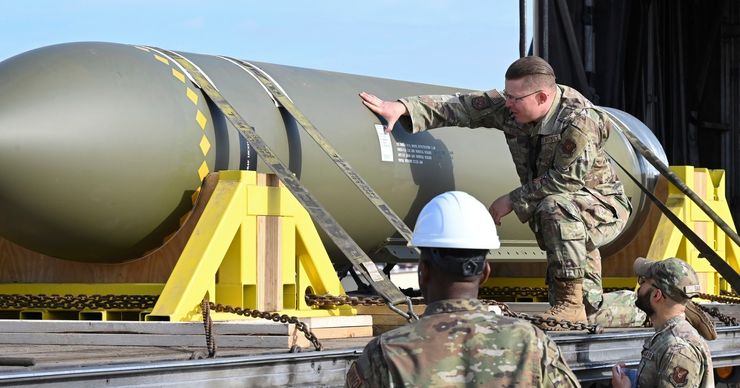
As tensions with Iran have escalated over its nuclear program, the U.S. military this month posted pictures of a powerful bomb designed to penetrate deep into the earth and destroy underground facilities that could be used to enrich uranium

DUBAI, United Arab Emirates (AP) — As tensions with Iran have escalated over its nuclear program, the U.S. military this month posted pictures of a powerful bomb designed to penetrate deep into the earth and destroy underground facilities that could be used to enrich uranium.

The U.S. Air Force on May 2 released rare images of the weapon, the

GBU-57, known as the “Massive Ordnance Penetrator.”

Then it took the photos down — apparently because the photographs revealed sensitive details about the weapon's composition and punch.

The publication of the photographs comes as The Associated Press reported that Iran is making steady progress in constructing a nuclear facility that is likely beyond the range of the GBU-57, which is considered the U.S. military last-ditch weapon to take out underground bunkers.

WHAT DO WE KNOW ABOUT AMERICA'S MASSIVE ORDNANCE PENETRATOR?

The U.S. developed the Massive Ordnance Penetrator in the 2000s as concerns grew over Iran hardening its nuclear sites by building them underground.

The Air Force posted images of the bombs on the Facebook page for Whiteman Air Force Base in Missouri. The base is home to the fleet of B-2 stealth bombers, the only aircraft that can deploy the bomb.

In a caption, the base said it had received two Massive Ordnance Penetrator bombs so a munitions squadron there could “test their performance.”

It is not the first time the Air Force has published photos and videos of the bomb that coincided with rising acrimony with Tehran over its nuclear program. In 2019, the U.S. military

released a video of a B-2 bomber dropping two of the bombs

. The Air Force did not respond to requests for comment on why it posted — and removed — the most recent set of photos.

WHAT DID WE LEARN FROM THE PHOTOS?

The latest photos revealed stenciling on the bombs that listed their weight as 12,300 kilograms (27,125 pounds). It also described the bomb as carrying a mix of AFX-757 — a standard explosive — and PBXN-114, a relatively new explosive compound, said

Rahul Udoshi,

a senior weapons analyst at Janes, an open-source intelligence firm.

The weight of the bomb, judging from the stenciling, shows the majority of it comes from its thick steel frame, which allows it to chew through concrete and soil before exploding. However, it remains unclear what the exact effectiveness of the weapon would be.

The Warzone, an Internet news site, first reported on the publication of the photographs. The AP contacted Whiteman Air Force Base and the Air Force’s Global Strike Command with questions about the images. Within a day, the Facebook post vanished.

Udoshi said the Air Force likely took them down because they revealed too much data about the bombs. “Immediate removal from the internet without comment (or) justification means there is a potential lapse,” Udoshi said.

WHAT ROLE WOULD THIS BOMB PLAY IN POTENTIALLY TARGETING IRAN'S NUCLEAR PROGRAM?

The AP reported on Monday that satellite imagery from

Planet Labs PBC

reveals Tehran has been digging tunnels in the mountain near the Natanz nuclear site in central Iran. Excavation mounds at the site suggest the facility could be between 80 meters (260 feet) and 100 meters (328 feet) under the ground, according to the experts and AP’s analysis.

Experts say the size of the construction project indicates Iran likely would be able to use the underground facility to enrich uranium as well — not just to build centrifuges. Those tube-shaped centrifuges, arranged in large cascades of dozens of machines, rapidly spin uranium gas to enrich it. Additional machines would allow Iran to quickly enrich uranium under the mountain’s protection.

That could be a problem for the GBU-57: In previously describing the bomb’s capabilities, the Air Force has said it could tear through 60 meters (200 feet) of ground and cement before detonating.

COULD THE UNITED STATES STILL TRY TO DROP THE BOMB?

U.S. officials have discussed using two such bombs in succession to ensure a site is destroyed. But even then, the new depth of the Natanz tunnels likely presents a serious challenge.

Further complicating any possible U.S. military strike is that the B-2 had been grounded for months since December when one caught fire after an emergency landing. On Monday, Gen. Thomas A. Bussiere, the commander of the Air Force's Global Strike Command, announced the B-2 grounding had been lifted.

“While the B-2 fleet safety pause is officially over, our ability to deliver nuclear deterrence and provide long-range strike was never in doubt,” he said in a statement.

___

Follow Jon Gambrell on Twitter at www.twitter.com/jongambrellAP.

___

The Associated Press receives support for nuclear security coverage from

the Carnegie Corporation of New York

and

Outrider Foundation

. The AP is solely responsible for all content.

More News

The Supreme Court is poised to make taxpayers fund anti-LGBTQ discrimination

Oct 27, 2026

The Supreme Court is poised to make taxpayers fund anti-LGBTQ discrimination

On November 3, the Supreme Court will hear St. Mary Catholic Parrish v. Roy, which squarely presents the question of whether the Constitution authorizes discrimination by religious schools. | Kent Nishimura/Los Angeles Times via Getty Images For years, the Supreme Court has flirted with the question of whether religious conservatives may simply ignore laws prohibiting discrimination against LGBTQ Americans. The Court’s Republican majority frequently rules in favor of business owners and institutions that refuse to serve gay or trans people. But these cases often rely on ad hoc reasoning that seems designed to give religious conservatives a narrow win without resolving broader questions about whether people with anti-LGBTQ religious views have an absolute right to violate civil rights laws. On November 3, however, the Court will hear St. Mary Catholic Parrish v. Roy, which squarely presents the question of whether the Constitution authorizes discrimination by religious schools. Given the Court’s past behavior in similar cases, it’s hard to imagine St. Mary ending in anything other than a victory for religious groups that wish to exclude sexual or gender minorities. The case also presents another, related question: When does the Constitution require states to subsidize religious institutions? The Republican justices’ recent decisions suggest that they are eager to make taxpayers spend a great deal more money to promote religion. The case concerns a Colorado law that pays for preschool education for all 4-year-olds in the state. Families with eligible children may choose from a broad range of private and public schools, including religious schools. But the state also bars schools that participate in this program from discriminating on the basis of sexual orientation or gender identity. Religious preschools that discriminate may continue to operate in Colorado. Although Colorado does have a broad ban on anti-LGBTQ discrimination, that ban exempts places that are “principally used for religious purposes.” So the sole issue in St. Mary is whether Colorado’s taxpayers must fund religious schools that engage in discrimination. Until fairly recently, the question of whether a state would fund religious education was up to the state itself. In 2002, the Court ruled in Zelman v. Simmons-Harris that states had broad leeway to decide whether to fund religious education. They could, if they chose to, set up private school voucher programs that include religious schools. But they could also choose only to fund secular education. In Carson v. Makin (2022), however, the Supreme Court abandoned this permissive approach. The case struck down a Maine program that offered private school tuition vouchers to students in sparsely populated areas where it was not cost-efficient for the state to operate a public school. Maine law provided that these vouchers could only be used at “nonsectarian schools,” but the Court’s Republican majority held that school voucher programs must include religious schools. The Colorado preschool program at issue in St. Mary, in contrast to the program in Maine, does not bar any school from participating because it teaches religion or is affiliated with a particular faith. The program merely requires all participating schools — be they Catholic, protestant, Jewish, Muslim, Hindu, or secular — to comply with an anti-discrimination law. The question in St. Mary, in other words, is whether religious schools can not only demand taxpayer funding, but also demand exemptions from generally applicable rules that apply to all other schools that accept that funding — essentially requiring taxpayers to pay for institutions that discriminate. The St. Mary plaintiffs want the Supreme Court to join together separate lines of religion cases The Court’s Republican majority has spent more than a decade remaking how the Constitution approaches religion — or, at least, rewriting the Court’s own precedents interpreting the Constitution’s provisions governing religious rights. One of those provisions guarantees everyone the right to “free exercise” of their own faith, while the other prohibits the government from creating an “establishment of religion.” Broadly speaking, the Court’s recent decisions have read the first provision expansively, while simultaneously reducing limits on the government’s ability to advance religion — or even holding that the government is constitutionally required to fund religious institutions. The St. Mary plaintiffs ask the Court to marry two branches of its recent religion decisions — one of which governs when people who object to a law on religious grounds are exempt from following it; the other asks when the government must fund religious schools. The first branch involves the Constitution’s free exercise clause, and this Court has fairly consistently held that, when the interests of religious conservatives conflict with LGBTQ Americans — or, really, anyone who takes a relatively liberal approach to sexuality — religious conservatives win. If you are a religious conservative, and you want an exemption from a law barring discrimination against LGBTQ people, this Court will make up a reason why you should win.  That said, while this Court consistently favors religious conservatives over queer people, the Court’s cases governing when a person of faith is exempt from a law that they object to on religious grounds are fairly incoherent and have not articulated clear legal rules. In Employment Division v. Smith (1990), the Court held that these exemptions are not available when someone challenges a “neutral law of general applicability,” meaning that the law applies with equal force to both religious and non-religious people or institutions. But Smith is, to put it mildly, not a beloved decision. Congress tried, semi-successfully, to overrule it when it enacted the Religious Freedom Restoration Act of 1993. And the Court’s most recent religion cases often read like the justices are looking for an excuse not to follow Smith.  In Masterpiece Cakeshop v. Colorado Civil Rights Commission (2018), for example, the Court ruled in favor of a Christian baker who refused to bake wedding cakes for same-sex couples. But the Court grounded that decision in facts very specific to the case, and Masterpiece Cakeshop offers judges little guidance on how they should decide other religion cases that don’t involve these unusual facts. Similarly, in Fulton v. Philadelphia (2021), the Court dodged a showdown over whether to overrule Smith and again resolved the case based on facts that were unique to that case. These are just two examples of the Court finding ways to not follow the rule it laid out in Smith, without overruling Smith or otherwise announcing a broad legal rule that governs free exercise cases. In their brief to the justices, the St. Mary plaintiffs list “at least eight different categories of cases where Smith does not control.” It appears that the Court has kept Smith in this strange limbo state — neither overruled nor followed in many cases — because several of the justices aren’t sure what legal rule should exist in its place. Indeed, in a concurring opinion in Fulton, Justice Amy Coney Barrett said outright that, while there are “serious arguments that Smith ought to be overruled,” she wasn’t yet prepared to do so because she wasn’t sure “what should replace Smith.” Still, the one thing that is clear from this Court’s recent precedents is that religious conservatives routinely prevail over LGBTQ Americans. The current Court has not disturbed decisions from the 1980s that held that religious business owners must pay taxes and comply with workplace regulations such as the minimum wage, but it consistently comes up with a reason to permit religious conservatives to engage in anti-LGBTQ discrimination whenever that issue comes up. That’s bad news for same-sex couples in Colorado, and a sign that the St. Mary plaintiffs are likely to prevail. The current crop of justices appear to be either unable or unwilling to come up with a coherent legal doctrine that can guide judges hearing religious liberty cases. The second line of cases at issue in St. Mary, meanwhile, deal with government subsidies. Nearly a quarter century ago, the Supreme Court held that states may fund religious education if they choose, but that they aren’t required to do so. The Court’s current majority, by contrast, handed down a series of decisions suggesting that separation of church and state is itself unconstitutional. These decisions culminated in Carson, which held that states that offer vouchers to pay for private school tuition must allow these vouchers to be spent at religious schools. So, realistically, there’s little chance that the plaintiffs in St. Mary will not succeed. If you accept both Carson and the Court’s decisions elevating religious conservatives over LGBTQ people, then it’s not like these plaintiffs’ argument is much of a stretch. It is nothing more than the logical next step in the Court’s broader efforts to shield religious conservatives from anti-discrimination laws, while also requiring nonbelievers to fund those conservatives’ schools. Carson established that a state violates the Constitution’s free exercise clause when it denies a government subsidy to a religious school. Meanwhile, the Court’s cases involving religious exemptions to the law are doctrinally incoherent, but the one theme that does unite them is that religious conservatives should not have to follow laws protecting LGBTQ people from discrimination. It is likely, in other words, that Colorado taxpayers will soon be constitutionally required to fund schools that refuse to serve the children of same-sex couples — or that otherwise engage in anti-LGBTQ discrimination that violates Colorado law. The Court is likely to hand down another ad hoc decision that doesn’t explain how judges are supposed to approach religious liberty cases One additional w

Central News Today

Central News Today breaks down complex issues with unique perspective, bringing high-quality journalism to millions of readers around the world.

NEWSLETTER