Sudan conflict brings new atrocities to Darfur as militias kill, rape, burn homes in rampages
Jul 28, 2023
Sudan's Darfur region became synonymous with genocide and war crimes two decades ago
CAIRO (AP) — Amna al-Nour narrowly escaped death twice. The first was when militias torched her family’s home in Sudan’s Darfur region. The second was two months later when paramilitary fighters stopped her and others trying to escape as they tried to reach the border with neighboring Chad.
“They massacred us like sheep,” the 32-year-old teacher said of the attack in late April on her home city Geneina. “They want to uproot us all.”
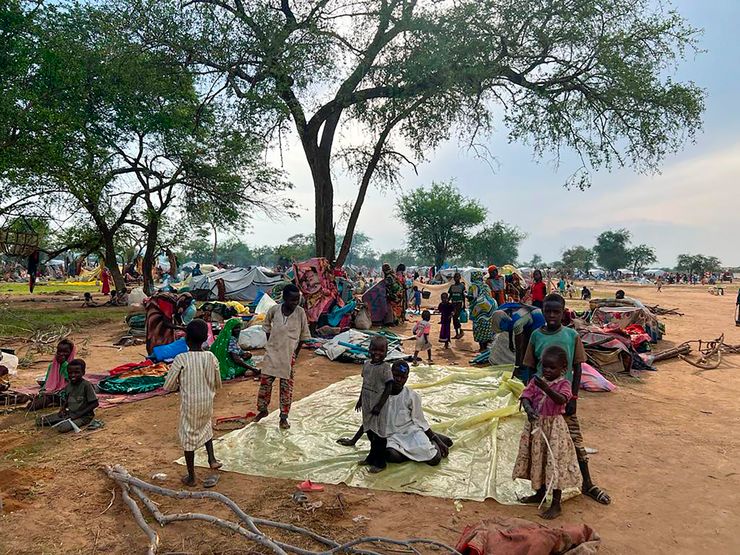
Al-Nour and her three children now live in a school-turned-refugee housing inside Chad, among more than 260,000 Sudanese, mostly women and children, who have fled what survivors and rights groups say is a new explosion of atrocities in the large western region of Sudan.
Two decades ago, Darfur became synonymous with genocide and war crimes, particularly by the notorious Janjaweed Arab militias against populations that identify as Central or East African. Fears are mounting that
that legacy is returning
with reports of widespread killings, rapes and destruction of villages in Darfur amid a nationwide power struggle between Sudan’s military and a powerful paramilitary group called the Rapid Support Forces.“This spiraling violence bears terrifying similarity with the war crimes and crimes against humanity perpetrated in Darfur since 2003,” said Tigere Chagutah, a regional director with Amnesty International. “Even those seeking safety are not being spared.”
Fighting
erupted in the capital, Khartoum, in mid-April between the military and the RSF after years of growing tensions. It spread to other parts of the country, but in Darfur it took on a different form -– brutal attacks by the RSF and its allied Arab militias on civilians, survivors and rights workers say.During the second week of fighting in Khartoum,
the RSF and militias stormed Geneina,
the capital of West Darfur state, located near the Chad border. In that and two other assaults since, the fighters went on a rampage of burning and killing that reduced large parts of the city of more than half a million people to wreckage, according to videos shared by activists.“What happened in Geneina is indescribable,” said Sultan Saad Abdel-Rahman Bahr, the leader of the Dar Masalit sultanate, which represents Darfur’s Masalit ethnic community. “Everywhere (in the city) there was a massacre. All was planned and systemic.”
The sultanate said in a report that more than 5,000 people were killed and 8,000 others were wounded in Geneina alone in attacks by the RSF and Arab militias between April 24 and June 12.
The report detailed three main waves of attacks on Geneina and surrounding areas in April, May, and June, which it said aimed at “ethnically cleansing and committing genocide against African civilians.”
The RSF was born out of the Janjaweed militias that during
the conflict in the 2000s
were accused of mass killings, rapes and other atrocities against Darfur’s African communities. Former President Omar al-Bashir later formed the RSF out of Janjaweed fighters and put it under the command ofGen. Mohammed Hamdan Dagalo
, who hails from Darfur’s Arab Rizeigat tribe.The RSF didn’t respond to repeated requests by The Associated Press for comment on the allegations concerning the recent violence, including rapes. On its social media, the paramilitary force characterized the fighting in Darfur as renewed tribal clashes between Arabs and non-Arabs.
In interviews with the AP, more than three dozen people and activists gave similar descriptions of waves of attacks by the RSF and Arab militias on Geneina and other towns in West Darfur. Fighters stormed houses, driving out residents, taking men away and burning their homes, they said. In some cases, they would kill the men and rape women and often shot people fleeing in the streets, al-Nour and other survivors said. Almost all interviewees said the military and other rebel groups in the region failed to provide protection to civilians.
“They were looking for men. They want to eliminate us,” said Malek Harun, a 62-year-old farmer who survived an attack in May on his village of Misterei, near Geneina. He said gunmen attacked the village from all directions. They looted homes and detained or killed the men.
His wife was killed when she was shot by fighters firing in the village market, he said. He buried her in his home’s yard. Arab neighbors then helped him escape and he arrived in Chad on June 5.
On July 13, the U.N. Human Rights Office said
a mass grave
was found outside Geneina with at least 87 bodies, citing credible information. The international group Human Rights Watch said it also documented atrocities includingsummary executions and mass graves in Misterei.
The Sudanese Unit for Combating Violence against Women, a government organization, said it documented 46 rape cases in Darfur, including 21 in Geneina and 25 in Nyala, the capital of South Darfur, as well as 51 in Khartoum.
The true number of cases of sexual violence are likely in the thousands, said Sulima Ishaq Sharif, head of the unit.
“There is an emerging pattern of large-scale targeted attacks against civilians based on their ethnic identities,” said Volker Perthes, the U.N. envoy in Sudan. The International Criminal Court’s prosecutor, Karim Khan, told the U.N. Security Council last week they were investigating
alleged new war crimes and crimes against humanity in Darfur.
Al-Nour, whose husband was killed in
a bout of tribal clashes in early 2020
, said assailants stormed her district of Jamarek in Geneina in late April and burned down dozens of houses, including hers. “They forced people to get out of their homes, then shot at them,” she said, speaking by phone from the Chadian border town of Adre.She and her children — aged 4, 7 and 10 — escaped with the aid of Arab neighbors. They kept moving from town to town amid clashes.
In mid-June, she and a group of 40 men, women and children started on foot down the 20-kilometer (12-mile) highway to the border, planning to escape to Chad. They were soon stopped at an RSF checkpoint, she said.
Holding the group at gunpoint, the fighters asked about their ethnicity. Two of the 14 men in the group were Arab, with fairer skin. The fighters abused and beat the others, who were darker skinned and had Masalit accents.
“You want to escape? You will die here,” one fighter told the Masalit. They whipped everyone in the group, men and women. They beat the men to the ground with rifle butts and clicked the triggers of their guns to frighten them. One man was shot in the head and died immediately, al-Nour said.
They took away the remaining men along with four women in their 20s, she said. She does not know what happened to them but fears the women were raped. They allowed the rest of the women and children to continue their trip.
Other refugees in Adre reported similar violence on the road to the border.
“It was a relief to reach Chad,” said Mohammed Harun, a refugee from Misterei who arrived in Adre in early June, “but the wounds (from the war) will last forever.”