Israeli protesters are calling for democracy. But what about the occupation of Palestinians?
Aug 3, 2023
Israel is being rocked by a wave of mass protests calling for the country’s democracy to be upheld
JERUSALEM (AP) — Israel is being rocked by a wave of mass protests calling for the country’s democracy to be upheld. But the pro-democracy movement lacks any clear message of opposition to Israel’s open-ended military rule over millions of Palestinians.
This contradiction reflects a widely held belief among Jewish Israelis that the conflict with the Palestinians is both intractable and somehow separate from Israel’s internal strife.
Critics of the protest movement, including Palestinians, say this is a significant blind spot and that such selective advocacy of democratic ideals shows how disconnected Israelis are from the harsh reality of those living under Israel’s occupation.
“It’s so ironic that they’re talking and protesting for democracy while at the same time it’s been a dictatorship for Palestinians for 75 years,” said Diana Buttu, a Palestinian commentator. “They’re afraid that their own privileges and rights are going to somehow be affected, but they won’t make the connection” with the occupation.
The protesters are demonstrating against the drive of Prime Minister Benjamin
Netanyahu's government to weaken the judiciary
by limiting judicial oversight on official decision-making and legislation.The protest movement says its limited message against the judicial overhaul is holding together one of the largest and most sustained
protest movements Israel has ever seen
, bringing tens of thousands of people to the streets for the last 30 weeks.Netanyahu's government, made up of ultranationalist and ultra-religious parties with close ties to the West Bank settler movement, says the overhaul will restore power to elected lawmakers and rein in what it says is an overly interventionist judicial system.
Critics see the legislative push, especially because it's driven by far-right and conservative religious parties, as an assault on Israel's democratic fundamentals and its weak system of checks and balances. They say it will open the door to serious infringements on personal liberties and the rights of women, the LGBTQ+ community and minorities that will set Israel on a path toward autocracy.
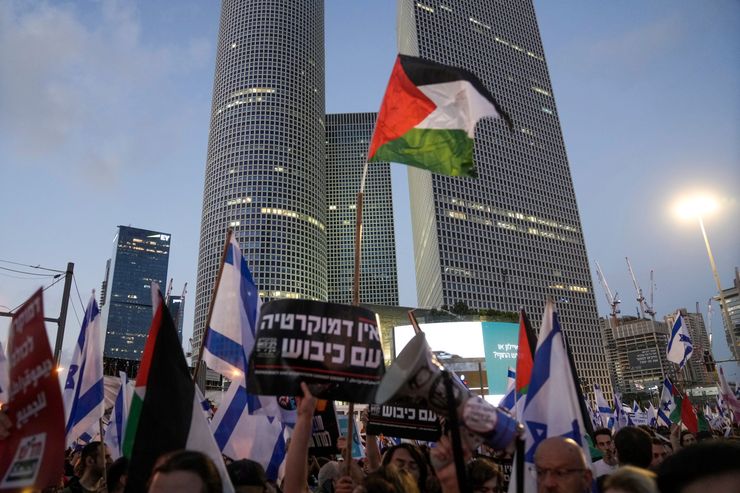
The protesters come from a wide swath of Israeli society. They chant “democracy or rebellion!” carry signs reading “Israel will remain a democracy,” and have unfurled a giant copy of the country's declaration of independence, which serves as an unofficial bill of rights, at various events.
But largely missing from
the raucous protests
is any meaningful reference to Israel's 56-year occupation of lands the Palestinians seek for their future state. A small contingent of activists waving Palestinian flags have taken part, but remain mostly on the fringe.In some cases, they have even been ostracized by organizers who feared that mentioning the occupation would somehow undercut the protest movement. Israel’s Palestinian citizens, who make up a fifth of the population,
have sat out the protests
in part because the demonstrations are ignoring the occupation.“The protest is against the reduction of the democratic space for Jews. Most Jews in Israel don’t have a problem with Israel
enforcing an apartheid regime
in the West Bank,” said Dror Etkes, a veteran anti-occupation activist.Despite his concerns, Etkes has made a point of participating in the protests. He sees the absence of occupation-related themes as a strategy meant to unite disparate groups against a more imminent threat. He said that if the government has its way, “people like me won't be able to protest” against the occupation.
The Associated Press contacted several protest leaders who either declined to comment or did not respond to questions about the contradictions.
Israel captured the West Bank, east Jerusalem and the Gaza Strip, territories the Palestinians seek for their hoped-for independent state, in the 1967 Mideast war. Israel withdrew from the Gaza Strip in 2005 and, along with Egypt, enforces a blockade on the territory. More than 700,000 settlers now live in the West Bank and east Jerusalem.
Palestinians in the West Bank live under limited autonomous self-rule, but Israel controls major parts of their lives, including movement and travel, construction permits in certain areas and significant parts of the economy. Israel's military also
frequently targets Palestinian areas
in what it says is a bid to thwart militancy.A two-tier legal system
is also in place in the West Bank, where large parts of Israeli law apply to Jewish settlers and Palestinians are subject to Israeli military law. Palestinians cannot vote in Israeli elections. Their own leadership, established as part of interim peace agreements in the 1990s, has repeatedly delayed Palestinian elections.While Palestinians in east Jerusalem hold Israeli residency and have access to certain social benefits, they face widespread discrimination. They can apply for citizenship but many choose not to, either on ideological grounds or because the process is too bureaucratic.
Those contrasting realities have
prompted rights groups to say an apartheid system has taken root
. Israel vehemently denies such claims. It says the West Bank is disputed territory whose fate should be determined through negotiations, which are long moribund.After years of deadly conflict with the Palestinians, many Jewish Israelis see the occupation as the inevitable by-product of a hopeless security situation. Others accuse the Palestinians of rejecting generous peace offers — a claim the Palestinians reject.
That frame of mind has prevented many Israeli demonstrators from grasping the contradiction in their struggle, said Amichai Cohen, a senior fellow at the Israel Democracy Institute, a Jerusalem think tank.
But he and others say the occupation is seeping into the protests, presenting a potential opening for an awakening. For one,
the main backers of the legal overhaul
arefirebrand West Bank settlers
who seek toexpand
andsolidify
Israel's domination over the Palestinian territories in part by weakening the court's oversight over its moves.The protests have also coincided with
a spike in Israeli-Palestinian fighting
, during which radical settlers have attacked Palestinian towns, most notably Hawara, setting cars and homes ablaze with a paltry response from Israeli security forces. The prominent protest chant “Where were you in Hawara?” emerged as a cry against perceived police brutality against protesters.Avner Gvaryahu, who heads Breaking the Silence, a whistleblower group of former soldiers, is a constant presence at the protests.
He has watched in frustration
as military reservists have refused
to continue serving to protest what they say is the disintegration of Israel's democracy, but kept silent over the occupation.Still, the reservist protest has shattered a taboo against military refusal, a tool he said might be used in the future by soldiers against the occupation.
“The mainstream is waking up,” he said.
Palestinians remain skeptical.
Shawan Jabarin, head of the Palestinian rights group Al-Haq, said he considers the protests an internal Israeli struggle to maintain a status quo that has only cemented the occupation.
“What democracy are you speaking about?’” he said. “Democracy doesn’t go in the same time with occupation.”