Israeli parliament takes first major step in Netanyahu's contentious overhaul, deepening divisions
Jul 24, 2023
Israel’s parliament has approved the first major law in Prime Minister Benjamin Netanyahu’s contentious plan to overhaul the country’s judicial system
JERUSALEM (AP) — Israel’s parliament on Monday approved the first major law in Prime Minister Benjamin Netanyahu’s contentious plan to overhaul the country’s justice system, triggering a new burst of mass protests and drawing accusations that he was pushing the country toward authoritarian rule.
The vote, passed unanimously by Netanyahu’s ruling coalition after the opposition stormed out of the hall, deepened the fissures that have tested the delicate social ties that bind the country, rattled the cohesion of its powerful military and repeatedly drew concern from Israel’s closest ally,
the United States
. It came just hours following Netanyahu'srelease from a hospital
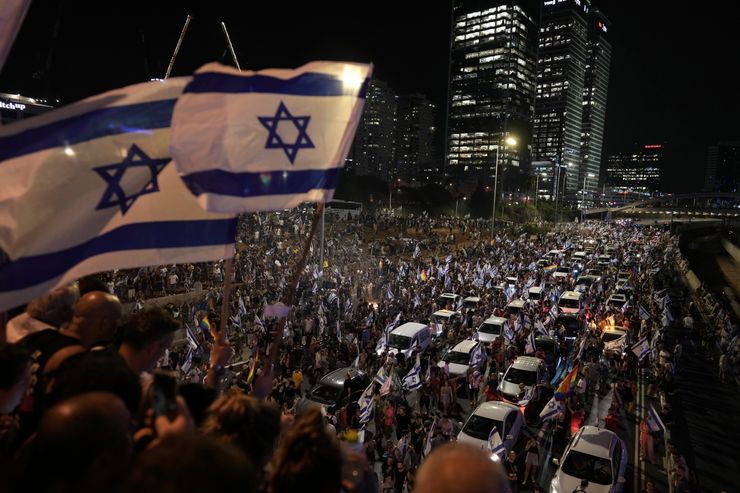
.As Netanyahu’s allies celebrated their victory and vowed to press ahead with more changes, thousands of protesters took to the streets of Jerusalem and Tel Aviv and opponents said they would challenge the new law in the Supreme Court.
“It’s a sad day,” opposition leader Yair Lapid said after the vote. “This is not a victory for the coalition. This is the destruction of Israeli democracy.”
The overhaul calls for sweeping changes aimed at
curbing the powers of the judiciary
, from limiting the Supreme Court’s ability to challenge parliamentary decisions to changing the way judges are selected.Netanyahu and his allies say the changes strengthen democracy by limiting the authority of unelected judges and giving elected officials more powers over decision-making.
But protesters see the overhaul as a power grab fueled by
personal and political grievances
of Netanyahu — who is on trial for corruption charges — and his partners.His allies, who include ultra-nationalist and ultra-religious parties, have called for increased West Bank settlement construction, annexation of the occupied territory, perpetuating military draft exemptions for ultra-Orthodox men, and limiting the rights of LGBTQ+ people and Palestinians.
The White House, which has repeatedly urged Netanyahu to pause his overhaul plan until he has a broad consensus, expressed regret. “It is unfortunate that the vote today took place with the slimmest possible majority,” it said.
Under the Israeli system, the prime minister governs through a majority coalition in parliament — in effect giving him control over the executive and legislative branches of government.
As a result, the Supreme Court plays a critical oversight role. Critics say that by seeking to weaken the judiciary, Netanyahu and his allies are trying to erode the country's checks and balances and consolidate power over the third, independent branch of government.
In a televised address Monday night, Netanyahu rejected such criticism. “Today we did a necessary democratic act, an act that is intended to return a measure of balance between the branches of government,” he said.
He vowed to seek renewed dialogue with the political opposition and called for national unity. “Let us reach agreements,” he said. “I extend my hand in a call for peace and mutual respect between us.”
As he spoke, Israel’s Channel 13 TV showed a split screen with a police water cannon spraying crowds of protesters.
In Monday’s vote, lawmakers approved a measure that prevents judges from striking down government decisions on the basis they are “unreasonable.”
The government’s critics say removing the standard of reasonability opens the door to corruption and improper appointments of unqualified cronies to important positions The Supreme Court, for instance, this year struck down Netanyahu’s appointment of a key ally for interior and finance minister as unreasonable because of past convictions for bribery and tax cheating.
With the opposition out of the hall, the measure passed by a 64-0 margin.
Justice Minister Yariv Levin, the architect of the plan, said parliament had taken the “first step in an important historic process.”
“This is just the beginning,” added National Security Minister Itamar Ben-Gvir.
Opposition lawmakers chanted “shame” and “government of destruction” before leaving the chamber.
The chant was a reference to the upcoming Jewish day of mourning, the Ninth of Av, which marks the destruction of two ancient Temples in Jerusalem. According to Jewish tradition, the Roman Empire succeeded in destroying the Second Temple because of Jewish infighting.
The grassroots protest movement, which has regularly drawn tens of thousands of people into the streets
for the past seven months
, condemned Monday’s vote by Netanyahu’s “government of extremists” and vowed to press ahead.“No one can predict the extent of damage and social upheaval that will follow the passage of the legislation,” it said.
Thousands of people, many waving blue-and-white Israeli flags, gathered outside the Knesset, or parliament, and the Supreme Court, and jammed Jerusalem’s main highway. Walls and fences were plastered with stickers reading “we won’t serve a dictator,” “democracy or rebellion” and “save Israel from Netanyahu.”
Police tried to clear the crowds with water cannons spraying skunk-scented water. Many protesters put plugs in their noses or held up sprigs of rosemary plucked from nearby bushes to try to control the stench.
“This puts us on the way to dictatorship,” said protester Danny Kimmel, a 55-year-old program manager. “You don’t do this to people who are protesting. It’s their right.”
Thousands of people also demonstrated in central Tel Aviv – the epicenter of months of anti-government protests. Scuffles took place between police and protesters, with at least eight people arrested and protesters lighting bonfires. Police said they arrested a driver who hit a group of protesters in central Israel, injuring three people
The overhaul has exposed
deep divisions in Israeli society
— much of it along religious, ethnic and class lines.While protesters represent a cross section of society, they come largely from the country’s secular middle class, while Netanyahu’s supporters tend to be poorer, more religious and live in West Bank settlements or outlying rural areas.
Many of his supporters are working-class Mizrahi Jews, with roots in Middle Eastern countries, and have expressed hostility toward what they say is an elitist class of Ashkenazi, or European, Jews.
Israel’s Palestinian Arab minority has largely stayed away from the protests, with many saying they do not feel like they have a stake.
The protests have largely avoided Israel’s 56-year occupation of lands the Palestinians seek for their hoped-for-independent state, fearing the issue might alienate supporters. Critics accuse the protesters of harboring a significant blind spot.
Further ratcheting up the pressure on Netanyahu, thousands of military reservists have declared their refusal to serve under a government they see as setting the country on a path to dictatorship — prompting fears that the
military’s preparedness could be compromised
.In his address, Netanyahu urged reservists to continue to serve and “leave army service out of the political debate.”
The vote came hours after Netanyahu
was released from the hospital
, where he had a pacemaker implanted, adding another dizzying twist to an already dramatic series of events.Yohanan Plesner, president of the Israel Democracy Institute, a Jerusalem think tank, said Monday's vote had exposed long-running weaknesses in Israel's system of government.
“The immediate outcome will be to escalate internal divisions within Israeli society and undermine Israeli security,” he said. Increased uncertainty, he added, "will also have a negative economic impact.”
___
AP correspondents Ilan Ben Zion, Sam McNeil and Julia Frankel contributed reporting.