Blinken warns rival Sudanese generals to respect latest truce or face possible sanctions
May 23, 2023

U.S. Secretary of State Antony Blinken has warned Sudan’s rival generals to abide by the latest cease-fire or face possible sanctions

CAIRO (AP) — U.S. Secretary of State Antony Blinken warned Sudan's rival generals to abide by the latest cease-fire or face possible sanctions as residents reported sporadic fighting Tuesday between the warring sides in the capital of Khartoum and a northern city.

Sudan descended into chaos after

fighting erupted in mid-April

between the country's military, led by

Gen. Abdel Fattah Burhan, and the paramilitary Rapid Support Forces,

commanded by Gen. Mohamed Hamdan Dagalo.

The fighting has killed hundreds, wounded thousands and turned Khartoum and other urban areas into battlefields. Early on,

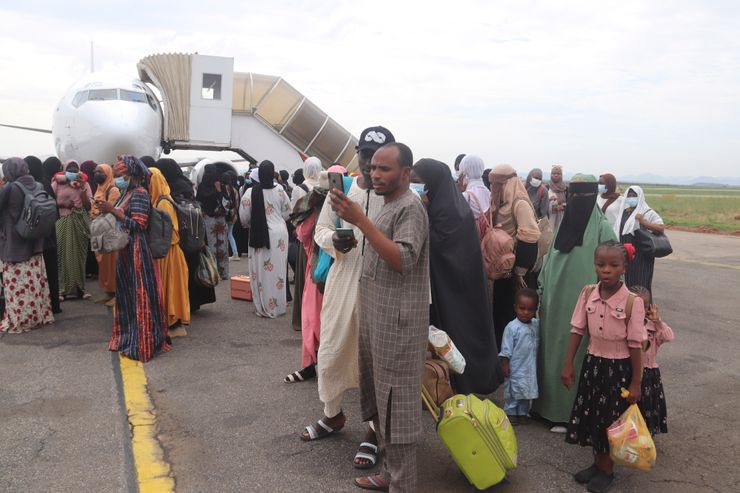
foreign governments raced to evacuate their diplomats and nationals

as thousands of foreign residents scrambled to get out of Sudan. More than 1 million Sudanese have been forced from their homes by the fighting.

Over the past weeks, the United States and Saudi Arabia have been mediating in

talks between the warring sides

, held in the kingdom. A new truce was announced over the weekend — the seventh attempt so far to stop the deadly violence in the East African nation. It went into effect on Monday night. All previous cease-fires have been violated.

In a video message posted by the U.S. Embassy on social media early Tuesday, Blinken said the fighting has been “tragic, senseless and devastating.”

The truce, he said, is meant to allow the delivery of humanitarian assistance and restore essential services and infrastructure destroyed in the clashes.

A remote mechanism, backed by the U.S., has been established to monitor the truce, Blinken added — a 12-member monitoring committee consisting of three representatives from the warring sides, three from the U.S., and three from Saudi Arabia.

“If the cease-fire is violated, we’ll know and we will hold violators accountable through sanctions and other means,” he said. “We facilitated the cease-fire, but it’s the responsibility of the Sudanese Armed Forces and Rapid Support Forces to implement it.”

Both sides agreed to stop hostilities and the looting of civilian properties and humanitarian supplies, as well as seizing civilian infrastructure such as hospitals, power planets, water pumps, and fuel stations.

Aid workers and civilians have reported widespread looting in Khartoum and elsewhere across the country, along with dire lack of basic services, medical care, food, and water. A doctor's group has also said that the RSF has seized hospitals. Allegations of sexual violence against women, including rape and gang rape in Khartoum and the restive western Darfur region, have also been reported.

Residents, meanwhile, said they heard laud sounds of gunfire and explosions Tuesday in parts of Omdurman, a city next to Khartoum, with military aircraft flying overhead. They also reported sporadic clashes around the military’s headquarters in Khartoum.

“Sounds of firefight are very close,” said Babakr Abdel-Rahman, an Omdurman resident, speaking over the phone, with loud sounds of gunfire and aircraft heard in the background. “They don’t respect people’s lives.”

Fighting was also reported in the northern city of Obeid, where RSF was said to have attacked the military headquarters and other parts of the city.


More News

The Supreme Court is poised to make taxpayers fund anti-LGBTQ discrimination

Oct 27, 2026

The Supreme Court is poised to make taxpayers fund anti-LGBTQ discrimination

On November 3, the Supreme Court will hear St. Mary Catholic Parrish v. Roy, which squarely presents the question of whether the Constitution authorizes discrimination by religious schools. | Kent Nishimura/Los Angeles Times via Getty Images For years, the Supreme Court has flirted with the question of whether religious conservatives may simply ignore laws prohibiting discrimination against LGBTQ Americans. The Court’s Republican majority frequently rules in favor of business owners and institutions that refuse to serve gay or trans people. But these cases often rely on ad hoc reasoning that seems designed to give religious conservatives a narrow win without resolving broader questions about whether people with anti-LGBTQ religious views have an absolute right to violate civil rights laws. On November 3, however, the Court will hear St. Mary Catholic Parrish v. Roy, which squarely presents the question of whether the Constitution authorizes discrimination by religious schools. Given the Court’s past behavior in similar cases, it’s hard to imagine St. Mary ending in anything other than a victory for religious groups that wish to exclude sexual or gender minorities. The case also presents another, related question: When does the Constitution require states to subsidize religious institutions? The Republican justices’ recent decisions suggest that they are eager to make taxpayers spend a great deal more money to promote religion. The case concerns a Colorado law that pays for preschool education for all 4-year-olds in the state. Families with eligible children may choose from a broad range of private and public schools, including religious schools. But the state also bars schools that participate in this program from discriminating on the basis of sexual orientation or gender identity. Religious preschools that discriminate may continue to operate in Colorado. Although Colorado does have a broad ban on anti-LGBTQ discrimination, that ban exempts places that are “principally used for religious purposes.” So the sole issue in St. Mary is whether Colorado’s taxpayers must fund religious schools that engage in discrimination. Until fairly recently, the question of whether a state would fund religious education was up to the state itself. In 2002, the Court ruled in Zelman v. Simmons-Harris that states had broad leeway to decide whether to fund religious education. They could, if they chose to, set up private school voucher programs that include religious schools. But they could also choose only to fund secular education. In Carson v. Makin (2022), however, the Supreme Court abandoned this permissive approach. The case struck down a Maine program that offered private school tuition vouchers to students in sparsely populated areas where it was not cost-efficient for the state to operate a public school. Maine law provided that these vouchers could only be used at “nonsectarian schools,” but the Court’s Republican majority held that school voucher programs must include religious schools. The Colorado preschool program at issue in St. Mary, in contrast to the program in Maine, does not bar any school from participating because it teaches religion or is affiliated with a particular faith. The program merely requires all participating schools — be they Catholic, protestant, Jewish, Muslim, Hindu, or secular — to comply with an anti-discrimination law. The question in St. Mary, in other words, is whether religious schools can not only demand taxpayer funding, but also demand exemptions from generally applicable rules that apply to all other schools that accept that funding — essentially requiring taxpayers to pay for institutions that discriminate. The St. Mary plaintiffs want the Supreme Court to join together separate lines of religion cases The Court’s Republican majority has spent more than a decade remaking how the Constitution approaches religion — or, at least, rewriting the Court’s own precedents interpreting the Constitution’s provisions governing religious rights. One of those provisions guarantees everyone the right to “free exercise” of their own faith, while the other prohibits the government from creating an “establishment of religion.” Broadly speaking, the Court’s recent decisions have read the first provision expansively, while simultaneously reducing limits on the government’s ability to advance religion — or even holding that the government is constitutionally required to fund religious institutions. The St. Mary plaintiffs ask the Court to marry two branches of its recent religion decisions — one of which governs when people who object to a law on religious grounds are exempt from following it; the other asks when the government must fund religious schools. The first branch involves the Constitution’s free exercise clause, and this Court has fairly consistently held that, when the interests of religious conservatives conflict with LGBTQ Americans — or, really, anyone who takes a relatively liberal approach to sexuality — religious conservatives win. If you are a religious conservative, and you want an exemption from a law barring discrimination against LGBTQ people, this Court will make up a reason why you should win.  That said, while this Court consistently favors religious conservatives over queer people, the Court’s cases governing when a person of faith is exempt from a law that they object to on religious grounds are fairly incoherent and have not articulated clear legal rules. In Employment Division v. Smith (1990), the Court held that these exemptions are not available when someone challenges a “neutral law of general applicability,” meaning that the law applies with equal force to both religious and non-religious people or institutions. But Smith is, to put it mildly, not a beloved decision. Congress tried, semi-successfully, to overrule it when it enacted the Religious Freedom Restoration Act of 1993. And the Court’s most recent religion cases often read like the justices are looking for an excuse not to follow Smith.  In Masterpiece Cakeshop v. Colorado Civil Rights Commission (2018), for example, the Court ruled in favor of a Christian baker who refused to bake wedding cakes for same-sex couples. But the Court grounded that decision in facts very specific to the case, and Masterpiece Cakeshop offers judges little guidance on how they should decide other religion cases that don’t involve these unusual facts. Similarly, in Fulton v. Philadelphia (2021), the Court dodged a showdown over whether to overrule Smith and again resolved the case based on facts that were unique to that case. These are just two examples of the Court finding ways to not follow the rule it laid out in Smith, without overruling Smith or otherwise announcing a broad legal rule that governs free exercise cases. In their brief to the justices, the St. Mary plaintiffs list “at least eight different categories of cases where Smith does not control.” It appears that the Court has kept Smith in this strange limbo state — neither overruled nor followed in many cases — because several of the justices aren’t sure what legal rule should exist in its place. Indeed, in a concurring opinion in Fulton, Justice Amy Coney Barrett said outright that, while there are “serious arguments that Smith ought to be overruled,” she wasn’t yet prepared to do so because she wasn’t sure “what should replace Smith.” Still, the one thing that is clear from this Court’s recent precedents is that religious conservatives routinely prevail over LGBTQ Americans. The current Court has not disturbed decisions from the 1980s that held that religious business owners must pay taxes and comply with workplace regulations such as the minimum wage, but it consistently comes up with a reason to permit religious conservatives to engage in anti-LGBTQ discrimination whenever that issue comes up. That’s bad news for same-sex couples in Colorado, and a sign that the St. Mary plaintiffs are likely to prevail. The current crop of justices appear to be either unable or unwilling to come up with a coherent legal doctrine that can guide judges hearing religious liberty cases. The second line of cases at issue in St. Mary, meanwhile, deal with government subsidies. Nearly a quarter century ago, the Supreme Court held that states may fund religious education if they choose, but that they aren’t required to do so. The Court’s current majority, by contrast, handed down a series of decisions suggesting that separation of church and state is itself unconstitutional. These decisions culminated in Carson, which held that states that offer vouchers to pay for private school tuition must allow these vouchers to be spent at religious schools. So, realistically, there’s little chance that the plaintiffs in St. Mary will not succeed. If you accept both Carson and the Court’s decisions elevating religious conservatives over LGBTQ people, then it’s not like these plaintiffs’ argument is much of a stretch. It is nothing more than the logical next step in the Court’s broader efforts to shield religious conservatives from anti-discrimination laws, while also requiring nonbelievers to fund those conservatives’ schools. Carson established that a state violates the Constitution’s free exercise clause when it denies a government subsidy to a religious school. Meanwhile, the Court’s cases involving religious exemptions to the law are doctrinally incoherent, but the one theme that does unite them is that religious conservatives should not have to follow laws protecting LGBTQ people from discrimination. It is likely, in other words, that Colorado taxpayers will soon be constitutionally required to fund schools that refuse to serve the children of same-sex couples — or that otherwise engage in anti-LGBTQ discrimination that violates Colorado law. The Court is likely to hand down another ad hoc decision that doesn’t explain how judges are supposed to approach religious liberty cases One additional w

Central News Today

Central News Today breaks down complex issues with unique perspective, bringing high-quality journalism to millions of readers around the world.

NEWSLETTER