Soom Foods Launches New Branding

Sep 13, 2021


PHILADELPHIA - September 13, 2021 - (Newswire.com)

Soom Foods, the premier tahini brand in the United States, is excited to announce their brand refresh. Soom Foods has anxiously awaited the announcement and roll-out of their new packaging, website, and the newest flavor in their lineup.

For the last year, Soom Foods has actively worked to develop premium branding that reflects the high-quality tahini inside the jar as well as a new website that improves customer accessibility. All of these new features will be launching to the public on Tuesday, September 14.

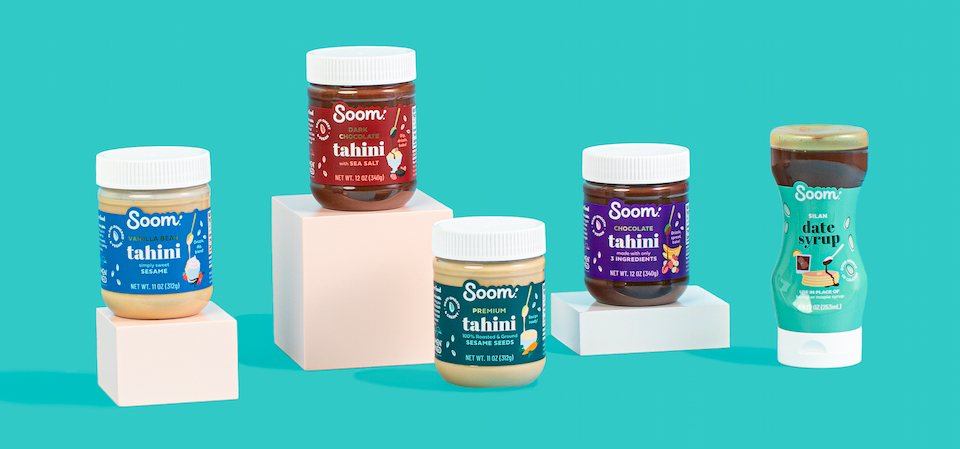
Most notably, the brand refresh will feature the latest flavor addition to Soom's product family. After much research and consumer feedback, Vanilla Bean Tahini will be making its debut on September 14, along with the packaging refresh. This new tahini flavor is made from real vanilla and premium Soom Tahini. The simple, yet classic, flavor shows off just how flavorful pure vanilla can be. Vanilla Bean Tahini will be available on the new website with additional online and retail outlets to follow.

Additionally, the new website will feature gifting and kitchen essentials sections to make it a one-stop-shop for food lovers, aspiring cooks, and gift givers. An anticipated favorite is the build-your-own tahini three pack, a customizable set that allows shoppers to create bundles of Soom tahini flavors like Chocolate, Dark Chocolate with Sea Salt, Soom's best-selling Premium, and the new Vanilla Bean. Accompanying the gift sets and custom bundle, Soom Foods will offer aprons, oven mitts, spatulas, and much more to ensure customers have everything they need to prepare any of the 100+ recipes on the site.

Soom's brand refresh has been in the works for over a year, in collaboration with fellow female-owned creative agency Pulp + Wire from Portland, ME. The team has revamped every element of the brand and has even created a wholesale ordering portal on the new website.

Amy Zitelman, Soom's co-founder and CEO, on the exciting launch of the brand refresh, "We are thrilled to have beautiful packaging that communicates the high quality of Soom's tahini. We worked tirelessly to ensure we considered every consumer touch point along the way, from the simplified ordering process for our online shoppers to the clear messaging on our jars for our retail customers. We certainly didn't forget our food service and restaurant partners either, creating an easy order portal and packaging they will be proud to display in their establishments."

The announcement of the brand refresh and launch of Vanilla Bean Tahini has been eagerly awaited by Soom Foods and is sure to delight tahini lovers seeking the highest quality tahini and innovative flavors. But this is just the start for Soom Foods. There is more exciting news just around the corner as Soom Foods continues their quest to make tahini a staple in every U.S. pantry.

Donald Schmidt

Publicity For Good

[email protected]


Press Release Service by Newswire.com

Original Source: Soom Foods Launches New Branding

More News

Why Francesca Hong is still on the campaign trail

Oct 10, 2026

Why Francesca Hong is still on the campaign trail

Francesca Hong, a representative in the Wisconsin State Assembly, poses for a photo with a supporter in Racine, Wisconsin, on July 19, 2026. | Sara Stathas for the Washington Post via Getty Images The Wisconsin gubernatorial race was one of the most closely watched Democratic primaries in the country this year, pitting a democratic socialist, state Rep. Francesca Hong, against Milwaukee Democrat David Crowley, who received the endorsement of the state’s sitting Democratic governor, Tony Evers. Hong lost the race, setting up Crowley to face Republican Rep. Tom Tiffany in the general election this fall. But she’s already back on the campaign trail, this time trying to help Democrats win a trifecta in the state: the governor’s race and both legislative chambers. Unifying the state’s voters to achieve that won’t be easy, though. Hong spoke with America, Actually host Astead Herndon about her own loss, Evers’s role in it, and whether or not the voters who felt so passionate about her own campaign would find enough to love in Crowley’s campaign — in particular on the increasingly important issue of data centers.  Astead and Hong also talked about what Wisconsin means for the Democrats nationally, and what lessons the party should take from her race, including her loss. “I said this, and I will continue to say it — the person who is most electable is the person who ended up getting the most votes, and that was Crowley this time around,” Hong said. “But I think there’s a disservice when you have the most powerful Democrat in the state choosing to ignore a lot of voters and people who were inspired and energized and coming out to participate in politics for the first time through our campaign. I think it was shortsighted to use electability almost as a fear tactic.” Below is an excerpt of Astead’s conversation with Hong, edited for length and clarity. There’s much more in the full show, so listen to America, Actually wherever you get your podcasts or watch it on Vox’s YouTube channel. Part of the reason we wanted to come here was because we saw you were getting back on the campaign trail, and specifically around that idea of energizing Wisconsin toward a trifecta. Now, just tell me the difference in terms of the importance of Democrats winning it all — not only the governor’s mansion, but both houses of the state legislature — versus just the governor’s mansion. How does that change the possibilities of what the party could do? For the last 16 years, a Republican majority in the state legislature has meant that passing the types of policies that we know can drastically improve the lives of everyday folks here in Wisconsin stalled. And we have a historic opportunity to flip the assembly and the state Senate and hold the governor’s mansion and the entire executive branch to a Democratic majority, meaning the opportunity to pass the policies that the majority of our state supports — things like increasing minimum wage, things like legalizing marijuana, codifying abortion.  We also need to repeal Act 10 [which dramatically restricted collective bargaining rights for public-sector employees]. Wisconsin is where workers’ rights, things like unemployment insurance, Social Security were born, and we moved backwards with the Republican majority. That’s all on the table with the Democratic trifecta. It also, though, raises the political standard of what Democrats would have to do to achieve that, and some of it goes through these more rural communities. Why do we think the party has fallen behind in more rural communities, and what could be done to reverse that? I think it’s important to look at what’s happened in the rural communities when we’ve seen manufacturing jobs leave the state, when we’ve seen fewer and fewer supports for our small farmers. And so much of this — what connects it — is actually the growth of massive wealth and corporate control and corporate greed, and more people feeling the impacts of that. There’s an opportunity right now to say, ‘Hey, Republicans have been in the legislature, they’ve been in power, and things have not improved for you or your community … Now’s the opportunity to make sure that we’re actually able to see our shared Wisconsin values of working hard and taking care of our kids be reflected back in Madison through laws.’ So much of your campaign was focused on data centers, stopping data centers. Should I think of that as a rural issue? I think the issue around data centers is an everyone issue. It’s a democracy issue. It’s people wanting to feel like there are folks who care about what happens to communities, and that they have control and an actual say in what happens in their communities. To that point, is it a mistake for David Crowley, the Democratic nominee, to have not gone as far as you did and say, “We won’t be building more data centers for a period of time”? He’s fighting for communities and community control when it comes to data centers. But it’s not a moratorium. But it’s not a moratorium. It isn’t, but he’s also committed to 100 percent renewable energy, clean energy to power data centers. And achieving that is going to be incredibly difficult, and it is going to be the developers having to pay their own way, and these are things that he’s committed to that we know can slow down the growth and development of data centers.  Have you had time to reflect on your primary loss? If you had to diagnose, why do you think you lost? I’m still doing a lot of reflection. But I think that I want to continue to look forward. And what I’ve learned from our election is that it’s so important to continue to stay grounded in becoming accessible to people. I think that as an organizer and an elected official, it’s my responsibility to continue to go to the people and remain very in touch with what’s going on on the ground. I have a couple more questions about the nature of the loss. Evers’s endorsement changed that race, so much so that your opponent David Crowley was able even to win in some smaller communities, like places where you were pitching yourself as the voice of more rural communities. Does that disprove any of this thesis around, say, data centers? If that was the top priority for Wisconsin voters, wouldn’t you be the nominee? I think it wasn’t all rural communities. It wasn’t all suburban communities. We saw certain demographics but also ZIP codes where we outperformed David significantly. And I think that where the governor’s endorsement played a bigger role was areas where he was also more popular.  Did it surprise you when Evers endorsed Crowley? I was disappointed. Why? I was disappointed because I was getting a lot of feedback from folks who hadn’t committed to any candidate yet that this felt like the governor was putting his thumb on the scale. I wanted to ask about electability, because it seemed as if Evers’s endorsement was about a fear that maybe you couldn’t win in November. So much of the primary concern was around the DSA label, even campaigning with folks like Hasan Piker. In retrospect, was any of that a mistake? We knew going in that we would have to encourage new voters to come out, folks who typically do not come out for primaries, quote-unquote low-propensity voters. And we knew that we would have to campaign in places where folks weren’t expecting to see a gubernatorial candidate. And those included Twitch streams. Those also included going to dive bars and bowling alleys and making sure that we were accessible and shaping our policies based on what the people were telling us they wanted to see happen and also what they wanted to see out of their governor. I think electability… I said this, and I will continue to say it — the person who is most electable is the person who ended up getting the most votes, and that was Crowley this time around. But I think there’s a disservice when you have the most powerful Democrat in the state choosing to ignore a lot of voters and people who were inspired and energized and coming out to participate in politics for the first time through our campaign. I think it was shortsighted to use electability almost as a fear tactic, when Democrats need to be inspiring and project a vision where everyone can see themselves in it as everyday working-class folks. When you’ve got a party that has struggled with elitism to then cave to an establishment narrative … being more afraid of labels when I’m hearing from people on the ground that they’re interested in solutions and solving problems, maybe somebody who knows the hustle of the service industry and running restaurants and has worked across the aisle to pass bipartisan legislation. There are ways that we can maneuver around labels and what the loudest narrative might be. I wish our governor hadn’t fed into that. To be fair, to your point, the establishment label doesn’t fully fit even someone like Crowley, who comes from a working-class background. But am I hearing that you think Evers’s move made your life in the general election more difficult? Is it harder to re-inspire if young people who are invested in the Hong campaign think that the establishment squashed them out? We still had over 300,000 votes. We lost by fewer than 4,000 votes. I had more votes than Evers did during his primary. That’s not squashing our voices. We’re still here, and it’s so important that people find avenues to continue to exercise their voice and their new organizing power. And I’m definitely going to continue to work to make sure that we get results and that we win the trifecta, and that’s the most important thing we should be focusing on right now. I hear why a trifecta matters in the state context, particularly the state policy. If I’m someone, though, who’s not in Wisconsin, who’s just worried about Donald Trump running amok in Washington, why should I care if Democrats win the governor’s mansion and the state legislature? Does that matter for folks outside of the state? Because we will start to

YOUR NEWS, OUR NETWORK.

Do you have Great News you want to tell the world?

Be it updates about your business or your community, you can make sure that it’s heard by submitting your story to our network reaching hundreds of news sites across 6 verticals.

Central News Today

Central News Today breaks down complex issues with unique perspective, bringing high-quality journalism to millions of readers around the world.

NEWSLETTER