Morey Plumbing, Heating & Cooling, Inc.: San Diego Heating Repair Starts Before the First Cold Night, and So Does Carbon Monoxide Safety

Oct 22, 2026

Morey Plumbing, Heating & Cooling, Inc. explains how a pre-season check can head off heating repair, and what California law requires for homes with gas heat.

San Diego, United States, October 22, 2026 -- In San Diego, many heaters sit unused for months at a time, and the first cold night is often when a homeowner learns the system no longer works. Morey Plumbing, Heating & Cooling, Inc. says scheduling HVAC maintenance before the heating season starts is the simplest way to catch problems early, and to reduce a safety risk that most homeowners cannot see or smell: carbon monoxide.

Why Do Heaters Fail on the First Cold Night in San Diego?
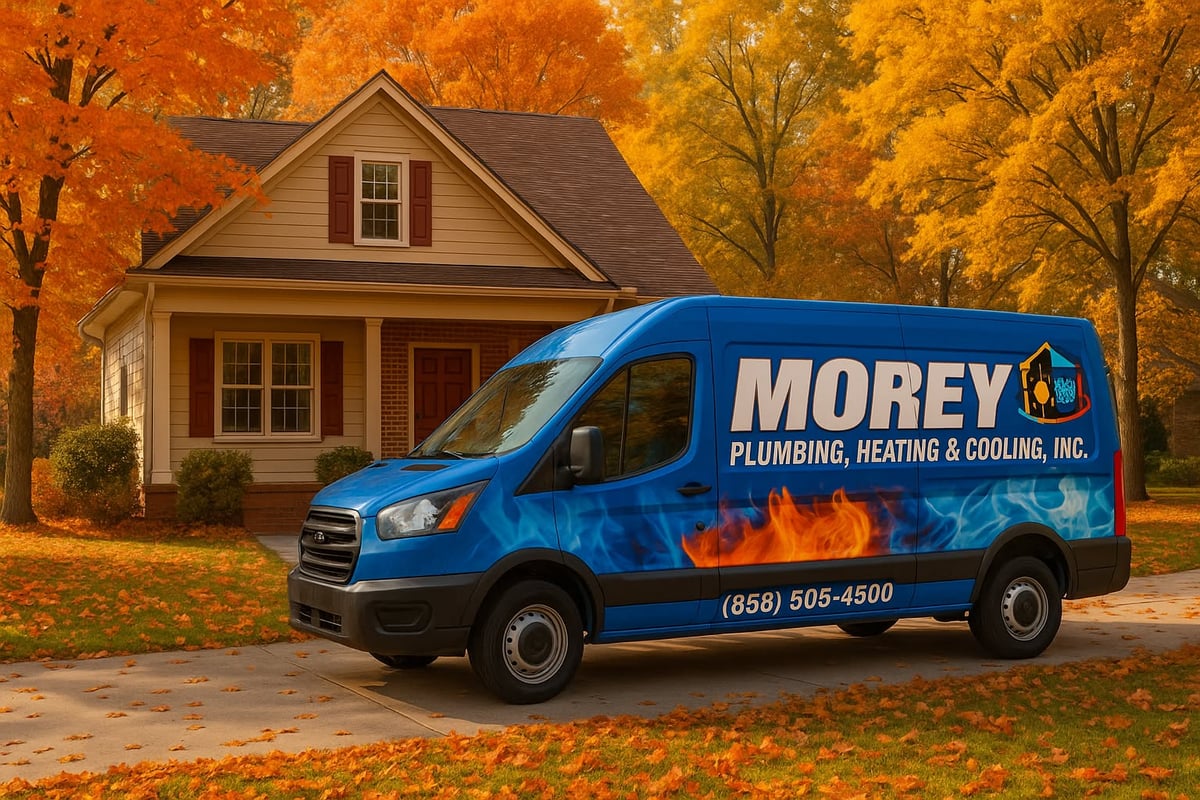
Morey Plumbing, Heating & Cooling, Inc. recommends scheduling a pre-season heating check before the first cold night to catch problems early and confirm your system is venting safely.

A heater that runs only a few weeks a year can develop problems during the long idle stretch. Dust and debris can build up around burners and in filters, and ignition and safety components can wear without anyone noticing, because nothing has asked them to work since last winter. Catching a clogged filter or a worn ignition part during a scheduled visit can turn what might have been an emergency furnace repair into a routine adjustment.

What Should a Pre-Season Heating Check in San Diego Include?

The U.S. Consumer Product Safety Commission recommends that fuel-burning heating systems, including chimneys and vents, be inspected and serviced every year by a qualified technician. Professional HVAC services for a pre-season check typically cover the furnace's electrical and mechanical components, thermostat controls, and automatic safety devices, along with the filter, burners and ignition, blower, and venting. The Commission also advises homeowners to ask that the inspection include the venting system, since cracked or blocked vents are one way combustion gases can enter a home.

Does California Require Carbon Monoxide Alarms?

Yes. Under the Carbon Monoxide Poisoning Prevention Act of 2010 (Senate Bill 183), codified in part at Health and Safety Code section 17926, a State Fire Marshal-approved carbon monoxide device is required in every existing dwelling unit that has a fossil fuel-burning heater or appliance, a fireplace, or an attached garage. The requirement took effect July 1, 2011 for existing single-family homes and January 1, 2013 for other existing dwelling units, and a combination smoke and carbon monoxide alarm satisfies both requirements.

Carbon monoxide is a colorless, odorless gas produced by the incomplete burning of fuels, including natural gas and propane. The Consumer Product Safety Commission reports that more than 200 people in the United States die each year from carbon monoxide produced by non-automotive consumer products, and that mild to moderate symptoms can be mistaken for the flu. An alarm is a last line of defense, not a substitute for inspection and heating repair. Anyone whose alarm sounds should get outside to fresh air and call emergency services before investigating.

“Most people don't think about their heater until the night they need it,” said Ken Morey for Morey Plumbing, Heating & Cooling, Inc. “A scheduled check costs far less than a no-heat call in the middle of a cold snap, and it's the best chance to confirm the system is venting safely. An alarm on the wall should be a backup, not the only protection a family has.”

What Should San Diego Homeowners Do Before Winter?

Morey Plumbing Heating & Cooling, Inc. recommends scheduling a professional heating inspection before regular use begins, testing every carbon monoxide alarm and replacing any that are expired or missing, replacing dirty filters, and keeping vents, flues, and the area around the furnace clear. Homeowners who notice unusual smells, soot, or a furnace that cycles on and off repeatedly should have it looked at promptly rather than waiting for a failure.

Anyone in San Diego County who has not had their heating system checked this year can contact Morey Plumbing, Heating & Cooling, Inc. for San Diego heating repair or a pre-season inspection.

About Morey Plumbing, Heating & Cooling, Inc.

Morey Plumbing, Heating & Cooling, Inc. is a family-owned, BBB-accredited contractor that has served San Diego County since 2000, providing plumbing, heating installation, heating repair, heating maintenance, air conditioning repair, AC maintenance, and air conditioning installation. Licensed and insured under Contractor's License #967435, the company backs its work with warranties of up to 10 years and offers free, no-obligation estimates. San Diego homeowners searching for heating repair are encouraged to contact Morey Plumbing, Heating & Cooling, Inc. at (858) 505-4500.

Contact Info:
Name: Ken Morey
Email: Send Email
Organization: Morey Plumbing, Heating, & Cooling, Inc.
Address: 7895 Convoy Ct Ste 13, San Diego, CA 92111
Phone: (858) 505-4500
Website: https://moreyphc.com/

Release ID: 89207027

In case of identifying any errors, concerns, or inconsistencies within the content shared in this press release that necessitate action or if you require assistance with a press release takedown, we strongly urge you to notify us promptly by contacting [email protected] (it is important to note that this email is the authorized channel for such matters, sending multiple emails to multiple addresses does not necessarily help expedite your request). Our expert team is committed to addressing your concerns within 8 hours by taking necessary actions diligently to rectify any identified issues or supporting you with the removal process. Delivering accurate and reliable information remains our top priority.

More News

The 2026 election could reshape healthcare

Oct 22, 2026

The 2026 election could reshape healthcare

New Yorkers march in support of universal healthcare this summer. | LightRocket via Getty Images Americans are furious about the state of our healthcare system.  A recent KFF poll found 60 percent of US adults worry about the cost of medical care — more than gasoline, food and groceries, or their rent or mortgage. One in three Americans say they worry every day or almost every day about their ability to afford healthcare, per a new survey from the Pew Research Center. There seems to be a growing appetite for reform, too: More than 65 percent of Americans say they support the government spending more tax dollars to lower healthcare costs.  Democrats are trying to weaponize those frustrations against the Republicans who currently hold Congress and the White House. By a 2-to-1 margin, voters say they trust Democrats over Republicans on healthcare. That could mean single-payer Medicare-for-all or a new public insurance option or maybe something else. What all this energy leads to will depend on what happens in November. The candidates themselves are framing the stakes in those existential terms.  Sign up for the Good Medicine newsletter Our political wellness landscape has shifted: new leaders, shady science, contradictory advice, broken trust, and overwhelming systems. How is anyone supposed to make sense of it all? Vox’s senior correspondent Dylan Scott has been on the health beat for a long time, and every week, he’ll wade into sticky debates, answer fair questions, and contextualize what’s happening in American health care policy. Sign up here. “Medicare for all is where we need to go,” Abdul El-Sayed, the Democratic candidate in the Michigan Senate race whose support for the policy has been widely covered, said during an August interview with CNN. “And my hope is, both coming out of the 2026 midterms and then out of 2028, that we’re going to be on our way to a Senate majority to be able to get this done.” Real change will have to wait for the 2028 presidential election and a new occupant in the White House. But this year’s midterms are still a make-or-break moment: The candidates who get elected this year, and how they shape the upcoming presidential primary debate and actions in Congress, will determine whether healthcare reform happens at all.  If you’re fed up with the state of American healthcare, and you want to see a change, you should show up for the midterms on Tuesday, November 3. Big midterm wins can beget big healthcare wins  The classic pattern in American elections is that more voters go to the polls during presidential campaigns than during the midterm elections when only House and Senate seats are on the ballot. Turnout has started to tick up for the midterms in recent years, but it still trails behind presidential years. Midterms suffer from the perception that there’s not as much at stake if the White House is not on the line. But that’s never been strictly true.  Midterm elections are extraordinarily important in shaping the future of policymaking, even if the payoff is delayed. They help determine both the character of the Congress that could eventually pass a major bill after the next presidential election, and the kind of ideas and policies that are going to be prioritized. “Voters should see 2026 and 2028 as the elections that will guide the next big change in our healthcare system,” said Natalie Davis, CEO and co-founder of the advocacy group United States of Care, in a statement to Vox. “These elections will be how voters’ demands are heard — and will tell us whether the next real window for change will come with serious reforms or missed opportunity.” A walk through the recent history of healthcare reform should help make the stakes of the 2026 elections clear. In 2006, the national mood looked similar to what we’re seeing today. A very unpopular Republican president was in office, and the country had soured on his agenda. George W. Bush’s foreign wars and his misguided attempt to overhaul Social Security gave Democrats an opportunity to win big in the 2006 midterms — and they did. Dems won more than 30 seats and secured a comfortable majority in the House. In the Senate, they won six seats and narrowly took control of that chamber too. It was a resounding rejection of the Bush administration, and it set up the next decade of Democratic policymaking. At the highest level, the midterms gave energy to the progressive wing of the Democratic Party, united as they were around their opposition to the Iraq War, and that energy carried over to the presidential primary. Barack Obama defeated Hillary Clinton and won the presidency, springboarding off of the excitement that started with the 2006 elections. Dems’ success in the midterms also helped put lowering healthcare costs at the forefront of the Democratic agenda. That encouraged both Obama and Clinton to develop detailed healthcare policy proposals during their primary campaigns and ultimately set the stage for the Democrats to pursue the Affordable Care Act once they had full control of the government in 2009. And then there is the literal size of the congressional majorities that parties need to pass their agenda. Voters may not spend much time thinking about whip counts, but one or two elections in a midterm year can ultimately decide the fate of the next president’s agenda.  Part of the reason Democrats were able to pass the ACA was that they built on their huge wins in 2006 with more wins in 2008 and held massive congressional majorities once Obama was sworn in. And once the debate over healthcare reform really got started, they needed every single vote. It was especially important in the Senate: Democrats had exactly 60 votes in 2009. That meant if all of them united together, they could pass filibuster-proof legislation — so long as nobody defected. That was only possible because in 2006 Mark Pryor won a Senate seat in Arkansas, Sherrod Brown triumphed in a Senate race in Ohio, and Jon Tester beat an incumbent Republican in Montana.  Without those wins in 2006, the Democratic legislative agenda in 2009 would probably have looked different. They might’ve had to pursue a more limited healthcare reform plan; maybe the ACA wouldn’t have passed at all. What kind of Democrats will be on the rise in 2028? The 2006 midterms both created the opportunity for the ACA — and set the limits on what the legislation could actually achieve. Democrats had that 60-seat Senate majority, but within it were many more moderate members. Policies like the public option (which would have authorized the government to create its own health insurance plan to sell alongside private insurance) couldn’t get sufficient support. That is the dilemma of policymaking: You need those swing-seat members to win, which often means tacking to the center, but you also can’t pass anything they won’t get on board with.  Nevertheless, that is a good kind of political problem to have, one which Democrats would be thrilled to face in January 2029. All of which brings us to 2026. What are we going to do now? It all starts with the vote count. Most projections expect the Democrats to win between 10 and 20 House seats. But the difference between 10 and 20 could be substantial. The cushier the majority, the further you can push the policy agenda. More than 30 House Democrats actually voted against the ACA, but they could still narrowly pass the bill because of the huge majority that they had started building in 2006.  If you live in one of the districts — like Arizona’s Sixth or Colorado’s Eighth or Florida’s 22nd, to name just a couple of the 21 toss-up races identified by the Cook Political Report this year — that forecasters say is competitive this year, you could have an outsized say in what the future of policymaking looks like. But even in safe districts, you should vote: Elections are the most reliable way we have to gauge public opinion, and strong victories for the candidates who prioritize healthcare send a message. The same goes for the Senate. If Democrats sweep all of the competitive races, they could have up to 55 seats in the Senate in 2027 — with a chance to build on it in 2028. If you are a voter in Kansas, Michigan, Ohio, Texas, Alaska, Maine, New Hampshire, or Iowa, your ballot carries extra weight for the next steps in US healthcare reform. If the Democrats can reach 60 votes again in 2029, they would have much more flexibility about what to pass. Even if they fall short of that magic number, the more of a cushion they have above 50, the more likely that their Senate leaders can find support for altering Senate rules for the filibuster and get an ambitious bill approved. How you can get involved this election If there is ever going to be a path to a true healthcare overhaul, it starts with this year’s elections. If you want to see a change, you can vote — and you can do more than that.  Talk to your neighbors. Phone bank for candidates you believe in.  You can even sign up to drive people to the polls on Election Day. The results of this year’s midterms will also set the terms of the debate among Democrats. We are likely to see “show” bills advanced by Dems next year that may have no chance of being signed by President Donald Trump, but that will give us a sense of what kind of policies the party wants to pursue and how much support there is for them. Believe it or not, the first Medicare prescription drug negotiations bill passed the House in 2007 after Democrats’ big wins in 2006 — even though the policy didn’t become law for another 15 years. The broader public may not pay much attention to this kind of doomed-to-fail legislation, but it is often a window into the future. “One challenge for Democrats is finding the next big health care idea beyond the Affordable Care Act that will resonate with voters and respond to their affordability concerns,” said Larry Levitt, executive vice president for health policy at KFF. “One big difference between now and 2006 i

YOUR NEWS, OUR NETWORK.

Do you have Great News you want to tell the world?

Be it updates about your business or your community, you can make sure that it’s heard by submitting your story to our network reaching hundreds of news sites across 6 verticals.

Central News Today

Central News Today breaks down complex issues with unique perspective, bringing high-quality journalism to millions of readers around the world.

NEWSLETTER