Dato’ Seri Ivan Teh: Navigating The Good, The Bad & The Ugly With AI

Nov 2, 2026

KUALA LUMPUR, November 2, 2026 -- Dato’ Seri Ivan Teh advocates approaching AI with “curiosity, not fear”. And, with enough common sense not to “believe everything it tells you”.
“Sometimes, we hear of this phrase “AI Hallucination” – which is very true. You do not need to accept all that AI tells you. You also do not need to become an AI engineer to participate in the AI economy but you do need to become AI-literate to discern for yourself right from wrong, good from bad,” he said.

“Continuous learning is essential. Build the skills that complement technology, critical thinking, creativity, communication, leadership and sound judgement. Then, experiment practically. Start with a small everyday problem, see how AI can help, verify the results and build confidence from there,” he added emphasising that the goal is not simply to learn how to use AI – but also to learn how to work alongside it responsibly.

Technology, he asserts, drives meaningful human impact when it is applied to “a genuine need than used for technology’s sake”. According to him, Data and AI for example, can help organisations “make faster and better-informed decisions, improve healthcare and public services, and create more personalised experiences”.

Drawing upon his own career experience throughout his career, he shared how he has witnessed data-driven solutions help businesses “become better versions of themselves” – more efficient, more responsive and more capable of serving people well.

“That is the impact that interests me, not simply making a system smarter but making the outcome better for the people who depend on it. Innovation becomes meaningful when intelligence is translated into better outcomes for people,”

“But there is one principle I would not compromise on: Progress must remain human-centred and responsible. We should be ambitious about what technology can do, and equally thoughtful about what it should do.

The goal is not simply to learn how to use AI; it is to learn how to work alongside it responsibly. “Do not compete with technology at being technology. Strengthen the qualities that make you distinctly human.”

Surviving AI & Rising Together

Rationalising that since no business succeeds in isolation, working alongside associations like the Malaysia Retail Chain Association (MRCA) is of importance.

“We grow because of our people, our customers and the communities around us. When we are fortunate to be in a position to contribute, I believe it is only right that we do so. I do not think of philanthropy as something grand. (Rather), it is about doing what you can, where you can, when the opportunity arises – through time, resources, experience or simply showing up,” said the Special Advisor of the MRCA Foundation who believes in the power of the strength in numbers.

“What I appreciate about the MRCA Foundation is the spirit behind it – bringing people together not simply as members of the business community but as members of society who recognise that we can collectively make a difference.

“One person can help but when a community brings together its ideas, networks, time and resources around a shared purpose, the impact can become much greater and more sustainable. My hope is that the Foundation continues to touch lives in practical ways – especially by helping people through difficult circumstances and creating opportunities for them to move forward with greater confidence and dignity,” he added.

Leading Responsibly In An Age of AI

In essence, leadership in the AI era is no longer just about driving innovation but is about taking responsibility for the consequences of innovation.

“Ambition has to travel with ethics, trust, security and human-centred thinking. Before deploying technology, leaders should ask: Does this create opportunity? Does it empower people? Does it improve lives?” he opined.

Raising the rhetoric: “Can we explain and stand behind the way it is being used? If the answer is no, then being technically possible is not enough. Human connection becomes even more important because empathy, judgement and purpose cannot be treated as optional features,” he shared.

“We are not simply building a more digital future but are determining what kind of future we want to live in,” he emphasised, explaining that leadership is simply not measured by “how quickly one adopts the future but by how responsibly one shapes it”.

“Relevance is not about adopting technology first; it is about creating value responsibly and continuously. The question is not only how far AI can go but how wisely we choose to take it there. I personally view AI as a form of technology with immense potential, (and) yet, at the same time I view it with much caution due to the possible impact it could bring to humanity – good and bad, depending on how humans use it. (Hence), I believe that the future of AI will be defined as much by our judgment as by our ingenuity,” he concluded.

Humanity & AI – A Double Edged Sword or Humanity Alongside AI

And this is the point he cannot emphasise enough in an Age of AI – where the end goal and one principle that should not be compromised on is that “Progress must remain human-centred and responsible”. He further stressed that “while society should be ambitious about what technology can do” it should also be “equally thoughtful about what it should do.”

“Technology may connect devices but humanity connects people,” he affirmed.

“Humanity is essential (in an Age of AI). AI can make us faster and more efficient but empathy, trust, creativity, humour and meaningful relationships remain profoundly human. Those qualities are what make organisations worth believing in and communities worth belonging to.”

But, at the heart of it all – even with AI changing the landscape of everything that once was familiar to us – is the crucial point he makes in that humanity is essential.

“AI can make us faster and more efficient but empathy, trust, creativity, humour and meaningful relationships remain profoundly human. Those qualities are what make organisations worth believing in and communities worth belonging to. Hence, the interesting paradox – in that, the more technology mediates our lives, the more we value genuine human connection.

“A perfectly optimised message is still not the same as someone looking you in the eye and truly understanding you. That applies in schools, workplaces, families and society at large,” he said.

The key distinction is that while technology may connect devices – it is humanity which connects people – hence, making this quality highly prized even as there are faster advances in AI agents, autonomous systems and humanoid robotics in the near future.

###

Source: "Genesis of AI" by Yvonne Yoong, Paparazzi, 27 October 2026. https://paparazzi.com.my/newthemepaparazzi/2026/10/27/12483/

Contact Info:
Name: Editor, Paparazzi
Email: Send Email
Organization: Paparazzi 360 Media
Phone: +60 17-220 2589
Website: https://paparazzi.com.my/newthemepaparazzi/

Release ID: 89208142

If you encounter any issues, discrepancies, or concerns regarding the content provided in this press release, or if there is a need for a press release takedown, we urge you to notify us without delay at [email protected] (it is important to note that this email is the authorized channel for such matters, sending multiple emails to multiple addresses does not necessarily help expedite your request). Our expert team will be available to promptly respond within 8 hours – ensuring swift resolution of identified issues or offering guidance on removal procedures. Delivering accurate and reliable information is fundamental to our mission.

More News

The bitter personal feud that could imperil a key Senate race for Democrats

Nov 2, 2026

The bitter personal feud that could imperil a key Senate race for Democrats

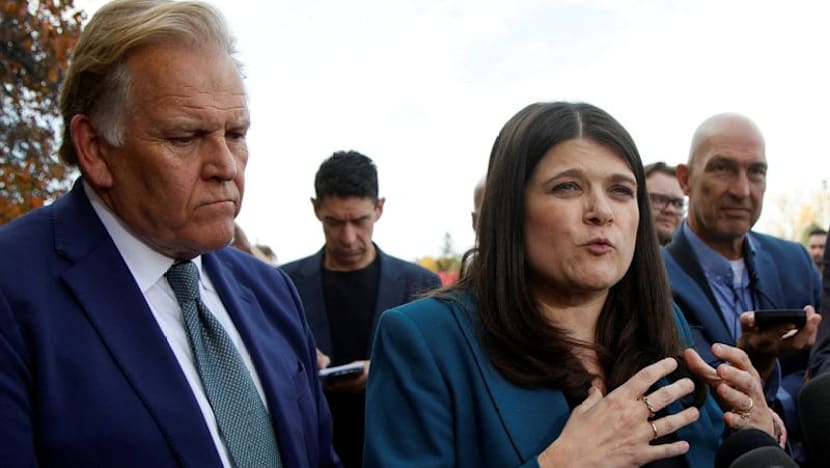
Former Rep. Mike Rogers, a Republican from Michigan and US Senate candidate, and Rep. Haley Stevens (D-MI), speak to members of the media following a service at Perfecting Church in Detroit, Michigan, on November 1, 2026. | Emily Elconin/Bloomberg via Getty Images Democrats in Michigan spent the weekend before Election Day angrily relitigating their Senate primary from months earlier after a defeated candidate, Rep. Haley Stevens, took back her endorsement of Democratic nominee Abdul El-Sayed — and backed the Republican instead. Key takeaways Rep. Haley Stevens had previously endorsed her Senate primary rival, Abdul El-Sayed, in his general election contest against Republican Mike Rogers, but she switched over to Rogers’s camp on Sunday. Stevens has cited comments Abdul El-Sayed made about Israel, and especially an ad from a PAC supporting El-Sayed that she viewed as antisemitic, in explaining her shift. Democrats, including many longtime Stevens supporters and staffers, near-unanimously denounced her for endorsing Rogers, often in harsh personal terms. The hope among Democrats is that this is essentially a personal feud and it won’t change many voters’ minds. On the surface, the fight gets to the heart of issues that have divided Democrats all year — between the party’s populist left-wing faction and its politically cautious centrists, and between vocal supporters and harsh critics of Israel — and that Republicans have hoped to ride to victory in Michigan in an otherwise difficult election year.  But it also is the culmination of a complicated and ongoing personal feud between the candidates — leading Democrats to hope that the damage might be contained, and that it was not representative of a broader shift within the electorate they’ve spent months working to consolidate.  How Sunday’s shock endorsement came about Initially, Stevens seemed to be enthusiastically on board with the party’s effort to bring Democrats together.  Shortly after Stevens narrowly lost the hard-fought Michigan Senate primary to Abdul El-Sayed, she endorsed El-Sayed and pledged her support in the general election. And though Stevens had begun to publicly criticize El-Sayed more in recent weeks, she reiterated in a CNN interview Wednesday that she’d vote for him. Multiple reports indicated she’d said the same to prominent Democrats as well, some as recently as Saturday.  But just two days before Election Day, Stevens stunningly reversed course — and endorsed El-Sayed’s Republican opponent, former Rep. Mike Rogers, on Sunday. The turnabout came after a days-long, tense back-and-forth between Stevens and El-Sayed, in which influential Democratic Reps. James Clyburn of South Carolina and Debbie Dingell of Michigan tried to negotiate an agreement for the former rivals to appear together at a unity event before the election.  Despite Stevens’s earlier endorsement, however, she had soured on El-Sayed in recent weeks because of the chief topic that divided them back during the primary: Israel. In particular, Stevens wanted El-Sayed to denounce an advertisement aired by a PAC backing him that she viewed as antisemitic, rather than just disavow any association with the ad, as he had done initially.  On Friday morning, Stevens posted an odd statement praising El-Sayed’s “expected condemnation” of the ad in advance of their joint campaign appearance. Then, by the end of the day Friday, El-Sayed’s campaign was letting it be known that the event was off, and that Stevens should stay away to avoid causing a distraction. Stevens did not take kindly to that. And Sunday, soon after appearing with Rogers at a Detroit church where she praised his record helping Black communities, Stevens released a video endorsing Rogers, mentioning how El-Sayed told her to “stay away” from his campaign. She added, “Who we are as Michiganders is not hate, and is not what we are getting out from our Democratic nominee right now.” Her endorsement was a coup for Rogers and his allies, who have been working to convince habitual Democratic voters — and Black and Jewish Michiganders, in particular — to treat El-Sayed as an extremist they should consider beyond the pale. And while polling is hardly any guarantee of the outcome, surveys have shown El-Sayed narrowly but consistently leading Rogers, suggesting this strategy was not getting the job done for Republicans. Yet it was also notable how quickly and vociferously Democrats across the board, including some of Stevens’s closest allies, spoke up to denounce what she had done.  More than half of Stevens’s congressional staff resigned in protest of her endorsement of Rogers. Michigan’s Democratic Party chair even declared that Stevens was no longer a member of the party and would not be permitted to rejoin it. And Senate Minority Leader Chuck Schumer (D-NY), who had strongly favored Stevens in the primary, called her actions “a despicable betrayal” and stressed that the party was “united in our support” for El-Sayed.  Some pointed fingers at Stevens’s fiancé Jason Turkish, an attorney and Democratic donor who endorsed Rogers days earlier, and did a media tour predicting Stevens would soon do the same. So the question is whether this last-minute drama exposes a real fissure inside the party — or whether this mess is more a tension of the specific personalities of the people involved. Why did Stevens turn against El-Sayed? At the heart of Stevens’s public criticism of El-Sayed were disputes over how to handle Israel, and where the line stood between criticism and antisemitism, a debate that has at times badly split Democrats this cycle. Stevens, first elected to Congress in 2018, has been a longtime champion of Israel. In 2022, when she was redistricted into the same district as Rep. Andy Levin — a Jewish Democrat who’d been sharply critical of the Netanyahu government — Stevens beat him in the primary, backed by $4 million in spending from AIPAC. (I interviewed Levin about that contest earlier this year.) But this year, in Michigan’s Senate primary, she faced El-Sayed — a very vocal critic of Israel and of the Democratic establishment’s backing of the Gaza war. And as the two sparred over Israel policy, AIPAC once again backed Stevens — this time, spending more than $30 million on the primary, the group’s biggest-ever investment in a single election. Stevens ended up losing the August primary by a margin of less than 1 percentage point; soon afterward she endorsed El-Sayed and hugged him at a unity breakfast. “It’s a big-tent party,” she said then. She said it was time to focus on beating Mike Rogers and the GOP, and that “the time for all this negative, nasty, the disunity stuff — it’s over.”  Yet they did not campaign together after that, and an account by CNN’s Edward-Isaac Dovere of the continuing tensions between them last week seemed to put most of that on the El-Sayed campaign; Dovere’s sources portrayed El-Sayed as uninterested in cultivating the relationship.  Then, Stevens told the New York Times, her doubts had been reignited because of an October 8 debate in which El-Sayed repeatedly refused to answer a moderator’s question about whether he thought Israel or Iran was a greater threat to the United States. (El-Sayed called it a “ridiculous hypothetical” and said both were “kind of dangerous,” with “one at risk of attacking us, one getting us into wars we have no business fighting.”) After that, on October 23, the pro-El-Sayed PAC released its controversial ad, in which people say grocery prices were high because too much government money is being spent helping Israel with “killing Palestinians” and funding Israelis’ universal healthcare. The ad closed by saying Mike Rogers was for “they/them” (over pictures of Israeli Prime Minister Benjamin Netanyahu and his far-right allies), while “Abdul El-Sayed is for you.” The ad — put out by Cenk Uygur, a left-wing commentator who is the uncle of streamer Hasan Piker — was reused from 2024 and had little money behind it. But it went viral online, and critics called it antisemitic.  The ad became a major sticking point in Stevens’s negotiations with the El-Sayed team. Turkish, her fiancé, publicly denounced it as antisemitic, blaming El-Sayed for putting “Jews at risk.” And though El-Sayed’s spokesperson had said the ad didn’t speak for their campaign, Stevens wanted a more unambiguous condemnation.  So on Friday morning, Stevens posted her unusual statement promising to campaign with El-Sayed on Sunday and praising his “expected” condemnation of the ad. “A unifying moment has arrived, our democratic nominee for U.S Senate disavows the Rebellion PAC ad made by Hasan Piker’s uncle that claims Jews are responsible for America’s economic woes. We have learned from party leaders and emissaries, as reported in the news media that he has,” Stevens posted on X. This was widely taken as an ultimatum to El-Sayed, and he decided not to play ball; word leaked out that his campaign did not want Stevens at any of their events anymore. “Our campaign is and always has been focused on addressing the most critical challenges Michiganders are facing,” he posted. “Congresswoman Stevens seems intent on litigating a primary that ended three months ago.” At a campaign event Saturday, El-Sayed was asked about the ad, and said: “That ad was not made by me, and I do not agree with the contents of that ad.” He also called it “not really of relevance to Michigan voters.”  Stevens’s endorsement of Rogers came the following day.  And after that came the backlash from Stevens’s fellow Democrats. The Democratic response to Stevens’s endorsement of Rogers Within hours, Stevens was effectively ostracized from the party, with even her own top aides abandoning her.  Stevens’s chief of staff Justin German said in a statement that he had served with her for eight years, and that he was “shocked and heartbroken” by her endorsement of Rogers, adding: “As of this morning, many members of our team have resigned, incl

YOUR NEWS, OUR NETWORK.

Do you have Great News you want to tell the world?

Be it updates about your business or your community, you can make sure that it’s heard by submitting your story to our network reaching hundreds of news sites across 6 verticals.

Central News Today

Central News Today breaks down complex issues with unique perspective, bringing high-quality journalism to millions of readers around the world.

NEWSLETTER