Building Thermal Insulation Market to Hit $31 Bn by 2026; Global Market Insights, Inc.

Nov 19, 2020
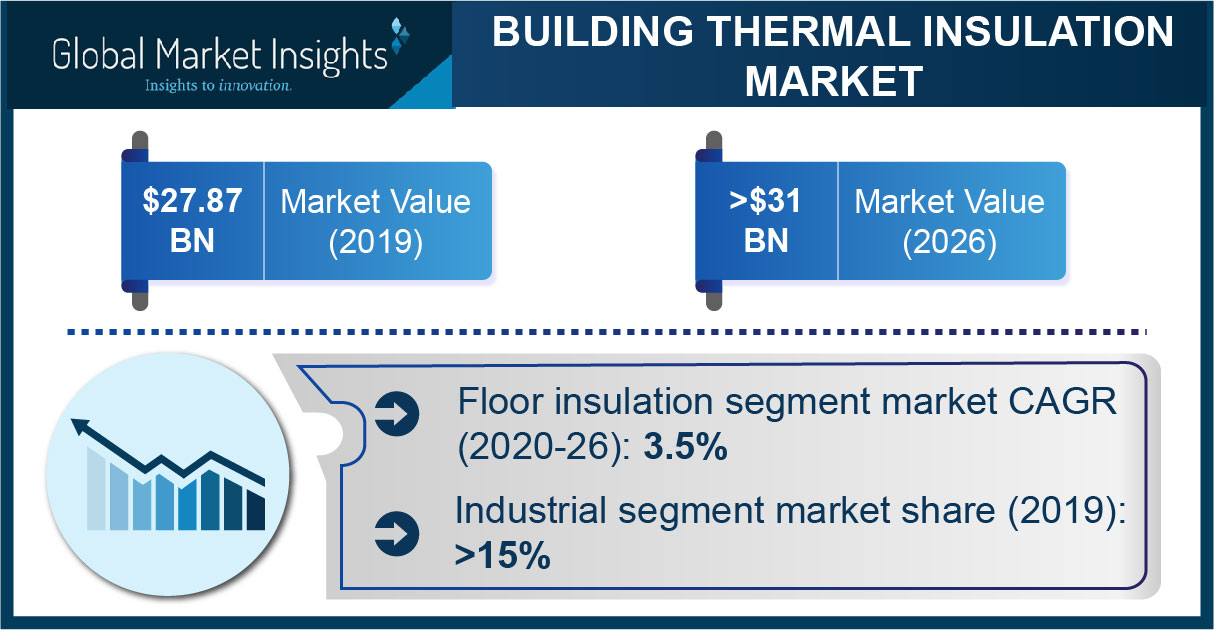
The building thermal insulation market for floor applications is projected to register a 3.6% CAGR through 2026, driven by a stringent regulatory environment in Europe and North America, as it helps in reducing the amount of heat that escapes from the floor.


SELBYVILLE, Del. - November 18, 2020 - (Newswire.com)

Global Market Insights, Inc. has recently added a new report on the building thermal insulation market, which estimates the market valuation for building thermal insulation will cross US $31 billion by 2026. Strict norms and policies regarding the significant reduction in atmospheric GHG emission levels will provide a positive scope for industry growth.

Building thermal insulation offers a high level of energy efficiency compared to traditional wooden framed and concrete constructions. As per the U.S Environmental Protection Agency, adding insulation can save 15% on heating and cooling costs. Insulation materials, such as ICF systems, reduce the requirements for active heating & cooling systems in tropical and semitropical regions. They also increase the time taken for the interior temperature to change with respect to the exterior temperature. Since a major part of the energy consumed nowadays is for operating air conditioners, reduced temperature changes decrease the energy consumed by air conditioners, thereby contributing to the reduction of carbon dioxide.

Request for a sample of this research report at https://www.gminsights.com/request-sample/detail/1755

Several governments across the globe have set tough carbon emission standards through international commitments with the UN Framework Convention on Climate Change. Increasing concerns on global warming and various government initiatives to reduce carbon emissions with collective support from the emerging countries are boosting the demand for structural insulation panels. However, the economic slowdown due to the COVID-19 pandemic has lowered construction output, creating a challenge for industry players.

The increase in demand for stone wool materials in the thermal insulation market is attributed to its natural fire protection characteristics. Stone wool insulation products are widely used across the globe due to various properties such as fire resistance and water-repellency. The segment is expected to reach USD 44.41 billion by 2026.

Floor insulation is done by introducing the insulation material under floorboards, generally on the ground floor of the house. The stringent regulatory environment in Europe and North America will drive floor insulations demand. Floor insulation will help in reducing the amount of heat that escapes from the floor, contributing around 15%. The floor insulation segment is expected to register a 3.6% CAGR by 2026.

The emergence of different industry players in the power, oil & gas, chemicals, automotive, and HVAC sectors are supplementing building thermal insulation's market growth. Global initiatives to reduce carbon emissions by improving energy efficiency and sustainability will propel the use of thermal insulation products in the industrial segment. The industrial segment held more than a 15% market share in terms of volume.

Browse key industry insights spread across 497 pages with 545 market data tables & 33 figures & charts from the report, "Building Thermal Insulation Market Share & Forecast, 2020 - 2026" in detail along with the table of contents:

https://www.gminsights.com/industry-analysis/building-thermal-insulation-market

The Asia Pacific building thermal insulation market is anticipated to grow at a significant rate owing to the rising government spending on infrastructure and rapid urbanization across the region. This will also lead to increased energy consumption due to the increasing demand for eco-friendly building insulation products. The region held around a 20% revenue share in 2019.

The market has a strong presence of various strong players with great production and distribution capacity. To maintain the market share, industry participants are engaging in M&A activities. In February 2016, Owens Corporation acquired Interwrap Group, a synthetic roofing underlayment manufacturer. This acquisition helped the company to expand its position in the roofing insulation component segment.

Some major findings of the building thermal insulation market report include:

  • The rapidly rising smart city projects around the world are propelling industry growth.
  • The increasing product penetration in the emerging markets, along with the rising construction industry, will propel market growth.
  • The rapid growth in supportive regulatory norms in North America and Europe has increased product demand.
  • Increasing needs for houses along with investments regarding infrastructure development are estimated to fuel the building materials market.
  • In developed countries including North America and Europe, aging infrastructure and the process of restructuring & maintaining it will drive product demand.
  • Mergers and acquisitions are likely to be key strategies among industry participants.

Browse the complete report's table of contents at https://www.gminsights.com/toc/detail/building-thermal-insulation-market

Partial chapters of the report's table of contents (ToC):

Chapter 4 Building Thermal Insulation Market, By Material

4.1 Global building thermal insulation market share, by material, 2019 & 2026

4.2 Open cell materials (Wool insulation)

4.2.1 Market estimates & forecast, 2016 - 2026

4.2.2 Global market estimates and forecast, by region, 2016 - 2026

4.2.3 Glass wool

4.2.3.1 Market estimates & forecast, 2016 - 2026

4.2.3.2 Global market estimates and forecast, by region, 2016 - 2026

4.2.4 Stone wool

4.2.4.1 Market estimates & forecast, 2016 - 2026

4.2.4.2 Global market estimates and forecast, by region, 2016 - 2026

4.2.5 Other open cell materials

4.2.5.1 Market estimates & forecast, 2016 - 2026

4.2.5.2 Global market estimates and forecast, by region, 2016 - 2026

4.3 Closed cell materials (Plastic foams)

4.3.1 Market estimates & forecast, 2016 - 2026

4.3.2 Global market estimates and forecast, by region, 2016 - 2026

4.3.3 Expanded polystyrene

4.3.3.1 Market estimates & forecast, 2016 - 2026

4.3.3.2 Global market estimates and forecast, by region, 2016 - 2026

4.3.4 Extruded polystyrene

4.3.4.1 Market estimates & forecast, 2016 - 2026

4.3.4.2 Global market estimates and forecast, by region, 2016 - 2026

4.3.5 Polyurethanes

4.3.5.1 Market estimates & forecast, 2016 - 2026

4.3.5.2 Global market estimates and forecast, by region, 2016 - 2026

4.3.6 Other closed cell materials

4.3.6.1 Market estimates & forecast, 2016 - 2026

4.3.6.2 Global market estimates and forecast, by region, 2016 - 2026

Chapter 5 Building Thermal Insulation Market, By Application

5.1 Global building thermal insulation industry share, by application, 2019 & 2026

5.2 Wall insulation

5.2.1 Market estimates & forecast, 2016 - 2026

5.2.2 Global market estimates and forecast, by region, 2016 - 2026

5.2.3 Internal wall insulation

5.2.3.1 Market estimates & forecast, 2016 - 2026

5.2.3.2 Global market estimates and forecast, by region, 2016 - 2026

5.2.4 External wall insulation

5.2.4.1 Market estimates & forecast, 2016 - 2026

5.2.4.2 Global market estimates and forecast, by region, 2016 - 2026

5.2.5 Air cavity wall insulation

5.2.5.1 Market estimates & forecast, 2016 - 2026

5.2.5.2 Global market estimates and forecast, by region, 2016 - 2026

5.3 Roof insulation

5.3.1 Market estimates & forecast, 2016 - 2026

5.3.2 Global market estimates and forecast, by region, 2016 - 2026

5.3.3 Flat roof insulation

5.3.3.1 Market estimates & forecast, 2016 - 2026

5.3.3.2 Global market estimates and forecast, by region, 2016 - 2026

5.3.4 Pitch roof insulation

5.3.4.1 Market estimates & forecast, 2016 - 2026

5.3.4.2 Global market estimates and forecast, by region, 2016 - 2026

5.4 Floor insulation

5.4.1 Market estimates & forecast, 2016 - 2026

5.4.2 Global market estimates and forecast, by region, 2016 - 2026

Browse the related report:

Insulation Market Size By Product (Fiberglass/Glass Wool, Mineral Wool, Plastic Foam [Expanded Polystyrene, Extruded Polystyrene], By Application (Residential Construction, Industrial, HVAC & OEM, Non-residential Construction) Industry Analysis Report, Regional Outlook, Growth Potential, Price Trends, Competitive Market Share & Forecast, 2019 - 2026

https://www.gminsights.com/industry-analysis/insulation-market

About Global Market Insights

Global Market Insights, Inc., headquartered in Delaware, U.S., is a global market research and consulting service provider; offering syndicated and custom research reports along with growth consulting services. Our business intelligence and industry research reports offer clients with penetrative insights and actionable market data specially designed and presented to aid strategic decision-making. These exhaustive reports are designed via a proprietary research methodology and are available for key industries such as chemicals, advanced materials, technology, renewable energy and biotechnology.

Contact Us:

Arun Hegde
Corporate Sales, USA
Global Market Insights, Inc.
Phone: 1-302-846-7766
Toll Free: 1-888-689-0688
Email: [email protected]


Related Links
Structural Insulation Panels (SIP) Market
HVAC Insulation Market


Press Release Service by Newswire.com

Original Source: Building Thermal Insulation Market to Hit $31 Bn by 2026; Global Market Insights, Inc.

More News

You’re supposed to get one free doctor’s visit every year. So why are so many Americans being charged?

Oct 1, 2026

You’re supposed to get one free doctor’s visit every year. So why are so many Americans being charged?

After moving to West Virginia last year, Steve Kuo signed up for a new insurance plan that would cost him $500 a month. But there was one upside: He knew he was entitled to a free preventive visit. He wanted to take advantage of it, so he made an appointment at a clinic near his new home. But then when he got there, they asked about his medical history and he mentioned prior kidney problems. When he received a bill a few weeks later, he had been charged twice for the same appointment: Once as that free preventive visit, once as an “office sick visit” because of the kidney conversation. He was flummoxed — and very annoyed, as he shared on social media. “No copayment means no copayment, exactly as stated in the insurance guidelines,” Kuo told me over email. “What is written and agreed upon should be honored.” He is far from alone. On Reddit, I easily found more than a dozen examples in just the past year of people getting a surprise bill for what they thought was going to be a free visit.  One woman posted a nearly $1,000 bill she’d received for what she thought was going to be a preventive gynecology visit. Another woman said that she ended up facing roughly $3,000 bills because she was given an ultrasound (which she said she didn’t request) at a preventive visit, and then her blood draw was sent to an out-of-network lab. Another person lamented that they had been billed $170 for an office visit because they had briefly mentioned back stiffness. It’s not supposed to be like this. Americans don’t get much when it comes to our healthcare, but most of us are supposed to be entitled to at least one thing: Once every year, no matter your health insurance, you can go to the doctor with the goal of preventing future health problems by discussing important vaccinations, cancer screenings, and cardiovascular health screenings. The Affordable Care Act made that the law in 2010. But more than 15 years later, people all over the country are walking into their doctor’s office, thinking they’re entitled to that one free visit every year, and walking out being billed for a sick visit, blood labs, and more. Researchers estimate that Americans spend tens of millions, maybe hundreds of millions of dollars every year on services that are supposed to be free under the ACA. Dr. Yalda Jabbarpour, a family physician in the Washington, DC, area and medical director of the Robert Graham Center for Policy Studies, told me she still deals all the time with people’s confusion about what a preventive visit really means. “Every single time I’m in the clinic, this issue comes up with a patient. And it’s sad that it comes up,” Jabbarpour told me. “In my mind, the blame is not to be put on the patient. The blame is not to be put on the physician. Really, this points to a bigger system issue that we need to solve.” How could a seemingly simple promise of one free annual doctor’s visit result in a situation so convoluted that patients and doctors are still struggling with it nearly two decades later? And how might we fix it? Patients are getting surprise bills from their doctors — and they’re pissed off The goal of the ACA was to expand coverage and make sure health insurance would be comprehensive to actually help people stay healthy. As part of that project, the authors of the law added a mandate for insurers to cover those services, including an annual wellness exam. The problem is, they did not define what the parameters of that preventive visit actually were, said Alex Hoagland, a healthcare economist at the University of Toronto.  “It didn’t establish a clear definition of…all the diagnosis codes and procedure codes and how frequently you get that combination within a year,” he said. “They don’t define what actually is preventive care and what’s not.” Do’s and don’t’s for a preventive visit: Topics that should be free to talk about: routine vaccinations, many cancer screenings, screenings for diabetes and cardiovascular health, contraception. Topics that could lead to you getting charged: chronic pain, prior medical problems, other physical and mental health symptoms (including depression). If you are a first-time visitor at a doctor’s office, you may also be charged a “new patient” fee. That has left each insurer to define a preventive visit on their own — and that’s where the perverse incentives that leave patients in a lurch begin. Preventive visits are supposed to be reserved strictly for screenings and talking about other preventive measures you can take to protect your long-term health, but you may get billed for an “office visit” or a “sick visit” if you talk about any specific symptom you’re experiencing, the same as if you had come in because you had the flu.  Health insurers have an incentive to keep the definition of preventive care as narrow as possible, so they have to pay fewer claims without any contribution from the patient. At the same time, doctors want to be paid for the actual services that they are providing. If somebody does bring up a bigger health problem during a preventive visit, then the doctor reasonably wants to be paid accordingly.  “I know, particularly in the healthcare space, it’s really popular to blame one party or another, and here I don’t think it’s a matter of corporate greed or physician incompetence or whatever,” Hoagland said. “It’s just a natural mismatch of incentives.” So the reality is that “one free doctor’s visit” sounds straightforward, but, in practice, it’s much more complicated. You as the patient might think of it as one visit, but in our fee-for-service healthcare system, where providers bill based on each specific thing they do, it’s not. The conversation about your vaccination may be free — but asking about your back pain is not. If you get blood tests ordered, that’s another line item. The list goes on. “It’s not like you walk into a doctor’s office and it’s just one thing that happens, right?” said Sabrina Corlette, co-director of the Center on Health Insurance Reforms at Georgetown University. “It’s multiple different things that are happening when you go into a doctor’s office.” Part of the problem may be that it’s one free visit. We Americans are consumers at heart: Tell us we’re going to get something for free and we want to take advantage of it. But having just one free visit may also lead to people bringing a laundry list of questions to that preventive visit, because they think of it as their only chance to ask everything of their doctor.  That makes it easy for the discussion to tip over into a sick visit — and not only does that lead to a surprise bill, it can also crowd out the conversation about prevention that the visit is supposed to be focused on. “What ends up happening a lot…is that a patient comes in for their annual visit, and in their mind, that is their time to bring up every single thing that’s been happening during the year, because they see it as the free visit to bring up everything that’s happened during the year. For some patients, that takes up the entire visit,” Jabbarpour told me. “They leave, and it’s like, ‘Oh my god, we forgot to do all the screening things: the vaccinations, the cancer screenings, and the cardiovascular risk screening.’ And then something happens down the line because you never address those screenings.” A 2021 study by Hoagland and Paul Shafer, both of Boston University at the time, estimated that Americans with employer-sponsored insurance had in 2018 alone paid between $75 million and $219 million in medical bills that should have been free. They were more likely to be charged for things like contraception or cholesterol and diabetes screenings, with individuals sometimes paying hundreds of dollars for those services. Hoagland told me he had been billed for preventive visits because he has type 1 diabetes and the system automatically categorized his appointment as a diabetic visit. Earlier this year, he co-authored a study that found people with chronic conditions were more likely to be charged for preventive care. Corlette said that she too had recently been charged for what was supposed to be a preventive visit after she mentioned an issue as an aside. And these are folks who study health care for a living. “It was literally maybe a 10-second conversation where I would ask the doctor a question about something,” she said. “And that triggered it.” Colonoscopies are another dramatic example of how this issue plays out in real life; Corlette told me the procedure was one of the first services where this fuzzy line between prevention and treatment under the ACA became obvious. People go under for what is supposed to be a preventive colonoscopy. But then their doctor finds a polyp and decides to remove it — good clinical practice, but as a result, their patient could end up being charged thousands of dollars because the colonoscopy was no longer preventive once that polyp was snipped. “All of a sudden, that would trigger what the patient thought was a preventive service into a cost-sharing obligation,” Corlette said. “Colonoscopies can be thousands of dollars. That was when we were first like, ‘Oh, yeah, this is a more complicated area than I think the lawmakers that drafted this provision originally envisioned.’” How the US could fix our preventive visit headaches The ACA’s preventive visit promise was clearly well-intentioned and it’s worth remembering that, if you look in the aggregate, more Americans are getting more free preventive care than they did before the law was passed. The problem, as much as anything, is expectations: People think they’re entitled to a free visit and are understandably frustrated when they get billed for it. “The difference is before the Affordable Care Act, maybe they anticipated some kind of cost-sharing,” Hoagland said. “But after, they expect it to be free.” Sign up for the Good Medicine newsletter Our political wellness landscape has shifted: new leaders, shady science, contradictory advice, broken

YOUR NEWS, OUR NETWORK.

Do you have Great News you want to tell the world?

Be it updates about your business or your community, you can make sure that it’s heard by submitting your story to our network reaching hundreds of news sites across 6 verticals.

Central News Today

Central News Today breaks down complex issues with unique perspective, bringing high-quality journalism to millions of readers around the world.

NEWSLETTER