Amid Coronavirus, Medical Journey Continues for 3-Year-Old Battling Life-Threatening Allergies

May 6, 2020

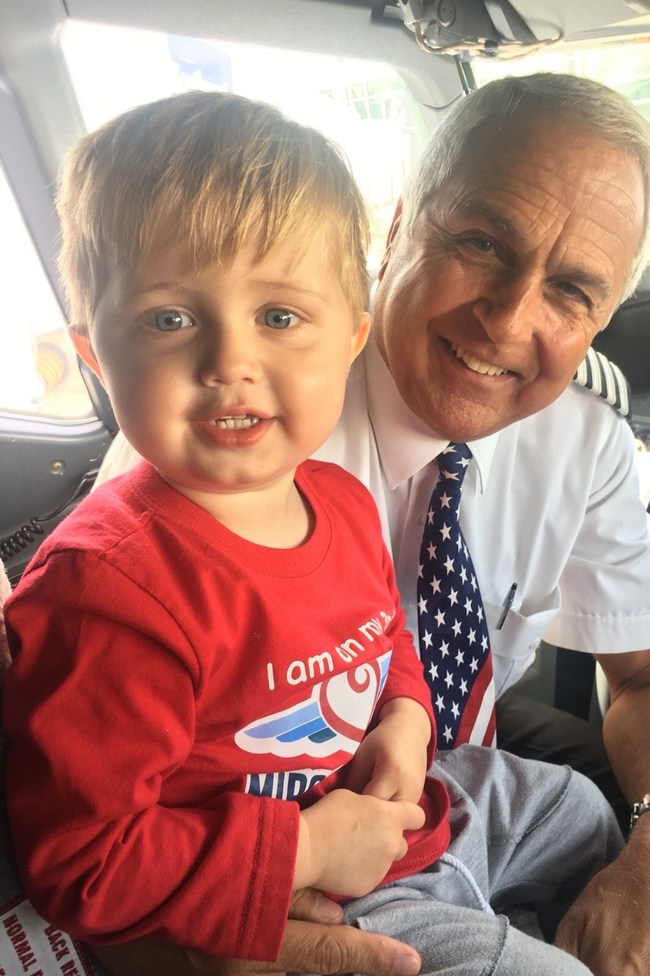
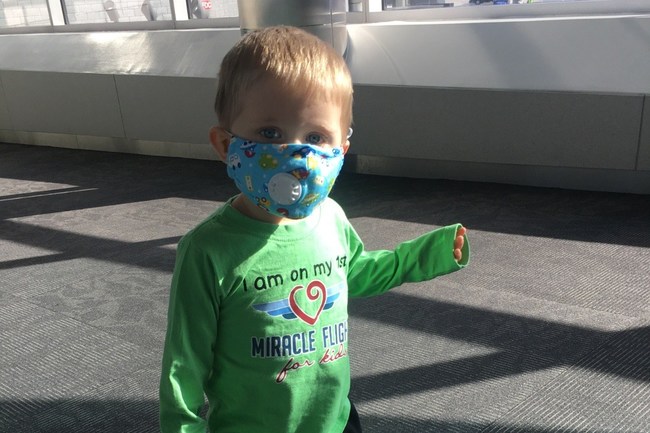
LAS VEGAS, May 7, 2020 /PRNewswire/ -- Eggs, garlic, peanuts and tree nuts are just a few of the 23 life-threatening food allergies that plague Asher Waff. But soon, the bright-eyed 3-year-old from Radford, Virginia, will have conquered them all. Asher and his parents leave this Sunday, May 10, on their seventh Miracle Flight to the cutting-edge medical treatment that's curing him. As Sunday also begins National Food Allergy Awareness Week, the Waffs are sharing their story to help other families find hope, even amid the coronavirus pandemic.
Continue Reading

For more than a year, the national charity Miracle Flights has been flying 3-year-old Asher and his parents to California free of charge, so Asher can receive the cutting-edge treatment that's helping him overcome 23 life-threatening food allergies. Since 1985, Miracle Flights has provided 129,438 flights to help families like Asher's reach specialized medical care far from home.

Even amid the coronavirus pandemic, 3-year-old Asher from Radford, Virginia, must continue his medical journey to find a cure for several life-threatening food allergies. The national charity Miracle Flights provides Asher and his parents with free plane tickets to California, where Asher has been undergoing treatment for more than a year. His next flight is Sunday, May 10, 2020-which also marks the beginning of Food Allergy Awareness Week.

The Waffs' battle began when baby Asher started solid foods—and a pea-sized taste of peanut butter brought on an immediate allergic reaction. Then a simple dinner turned nearly fatal when garlic bread threw Asher into anaphylactic shock. Soon came another blow: Asher was diagnosed with asthma, increasing his risk of fatal anaphylaxis from a food allergy by 50 percent.

"We would lose sleep at night worrying about Asher's future. How would he ever go to preschool or kindergarten? How could he possibly go to college and live in a dorm?" says Rachel. "An allergist that offered treatment for all of Asher's allergies seemed nonexistent."

Hope came when the family discovered the Tolerance Induction Program at the Southern California Food Allergy Institute, which offered a treatment that could send all of Asher's allergies into remission within 14 to 16 months. The only problem: the exorbitant cost to reach the medical facility – 2,000 miles away – every five to eight weeks. On top of medical bills, lodging, rental cars and time off from work, the cost of airfare added a tremendous financial burden to the family.

"Travel alone could have cost us at least $20,000—but not going wasn't an option," says Rachel. "We would have taken out a second mortgage. We would have made it happen."

Fortunately they didn't have to. Through the Institute's parent support group, the Waffs heard about Miracle Flights, the national nonprofit that provides free plane tickets to children and adults who need access to medical care not available in their local communities. The charity provides commercial flights to medical facilities throughout the U.S., as many times as necessary for patients and their parents or caregivers.

Throughout the coronavirus pandemic, Miracle Flights has continued to work with commercial airlines to ensure patients can reach the specialized, distant medical care they need.

"With the support of their doctors, many of our families are making the difficult decision to fly right now, because the risk of not flying—and not getting that specialized care—is too great," says Miracle Flights CEO Mark E. Brown. "For patients like Asher, whose treatment is progressive, a delay in care could cause a medical setback."

Asher took his first Miracle Flight to treatment in February 2019 and has now overcome half of his food allergies. The family hopes he'll tackle the rest in three more visits.

To help Asher and other children continue their journey to life-changing medical care, or to request a Miracle Flight for your family, visit miracleflights.org.

About Miracle Flights

Miracle Flights is a 501(c)(3) nonprofit organization that provides free medical air transportation to children and adults via commercial airlines throughout the United States. The organization, founded in 1985, has provided 129,438 flights and books more than 600 flights per month. To request a flight, learn more or donate, call 800-359-1711 or visit miracleflights.org. Like us on Facebook and follow us on Instagram.

Press Contact: Erika Koff: (702) 261-0494 or [email protected]

SOURCE Miracle Flights

Related Links

http://miracleflights.org

More News

The uncomfortable truth about aquariums

Sep 22, 2026

The uncomfortable truth about aquariums

Young visitors watch the beluga whales at L'Oceanogràfic in Valencia, Spain. | Miguel Candela/SOPA Images/LightRocket via Getty Images This story appeared in Today, Explained, a daily newsletter that helps you understand the most compelling news and stories of the day. Subscribe here. Four beluga whales have died in a month at one of America’s top-rated aquariums — a tragic development and, arguably, a reason to revisit the ethics of zoos. (More on that in just a minute.) The latest cetacean casualty, a 26-year-old female named Osiris, died at Chicago’s Shedd Aquarium yesterday. She follows 34-year-old Beethoven, a longtime resident of the aquarium, as well as 20-year-old Rain and 23-year-old Peekachu, who died in late August and early September.    Osiris, Rain and Peekachu were all part of the Marineland diaspora: a group of four dolphins and 30 beluga whales that rescuers have worked to relocate since the 2024 closure of a scandal-plagued theme park in Niagara Falls, Canada. This summer, the animals were successfully transferred to aquariums and marine parks in the US and Spain. That was a frankly incredible undertaking involving padded shipping containers, a police-escorted convoy and a chartered plane.  But in some regards, the international flight wasn’t even the hardest part of the whales’ journeys. Some of the animals have struggled to thrive in their new environments — even when those environments are state-of-the-art, like Shedd.  In a blog post announcing Osiris’s death, the aquarium noted that its rescued whales had been under 24-hour supervision and receiving intensive, specialized care. The aquarium is still investigating the cause of death for all four whales.  Go a little deeper View Link Believe me when I tell you that it gives me no pleasure to write the following paragraphs. I really love aquariums. In fact, as a kid, I grew up visiting the now-shuttered and much-maligned Marineland.  But incidents like these back-to-back deaths should prompt us all to ask ourselves who aquariums and zoos are actually for. And the answer, I regret to tell you, is frequently not “the animals” — though zoos and aquariums have, since the mid-20th century, marketed themselves as both tourist attractions and important players in wildlife education and conservation.   As my colleague Kenny Torrella writes, these institutions and their defenders argue they protect animals in three ways: first, by raising money for wildlife conservation projects; second, by helping to reintroduce vulnerable species back into the wild; and third, by inspiring visitors to take an interest in the environment. The Shedd Aquarium’s motto, for instance, is “For Love of Waterkind.”  It’s worth scrutinizing those purported virtues, however — even when prestigious and reputable institutions like Shedd are making them. On one hand, there is merit to the claim that zoos and aquariums fundraise for wildlife conservation: In 2022, the latest year for which data is available, one group of accredited zoos and aquariums spent more than a quarter of a billion dollars on habitat projects.  The evidence is thinner on the other points, though. It’s incredibly rare for aquariums and zoos to reintroduce endangered species back into the wild — that’s very difficult to do. And surveys of zoo and aquarium visitors show that merely seeing a wild animal in a tourist setting doesn’t generally galvanize people on matters of welfare or stewardship. Living in captivity in that tourist setting, however, can be stressful (or worse) for the animals themselves.  But what would a humane alternative look like? Even if zoos and aquariums stopped catching animals in the wild, that would still leave many thousands who are injured, orphaned, born in captivity, or otherwise accustomed to human care.  When it comes to whales, one nonprofit advocacy organization is already working on an alternative: a 110-acre coastal sanctuary for “retired” whales. That project, however, is still a long way from completion. And in the meantime, it’s up to consumers to decide whether the stated benefits of zoos and aquariums outweigh the potential harms to the animals they exhibit. One link for later ➨ Beware the trap of “moral perfection.” We should all endeavor to live lives that embody our values, sure. But if you never board a plane because you care about the climate, or you never take your kid to zoos because you read the arguments above, then you might end up with a smaller, less-lived life. And that’s no good, either.  Before you go… Did you know…that there have been “revolutionary” advancements in Alzheimer’s treatments in just the past five years? Two new drugs both markedly slow the progress of dementia. Today’s trivia: Geography time! What country is bordered by Chad to the east and Mali to the west? Hint: It is the second-largest landlocked African nation. (You can find this and other brain puzzles in Vox’s daily crossword. Look for the answer in tomorrow’s edition.) Yesterday’s trivia: Yesterday we asked you for the classic Broadway star who first sang hits including “There’s No Business Like Show Business.” That would be Ethel Merman, whom one biographer dubbed “the most successful musical comedy performer of her generation.”

YOUR NEWS, OUR NETWORK.

Do you have Great News you want to tell the world?

Be it updates about your business or your community, you can make sure that it’s heard by submitting your story to our network reaching hundreds of news sites across 6 verticals.

Central News Today

Central News Today breaks down complex issues with unique perspective, bringing high-quality journalism to millions of readers around the world.

NEWSLETTER