Aerial Technologies Enables Broader Access to Affordable Remote Care Utilizing Your Home WiFi

May 4, 2020

MONTREAL, May 5, 2020 /PRNewswire/ -- Aerial Technologies, a Montreal-based AI company, announced today the launch of the world's first AI-based ambient Remote Care Solution. Aerial's leading team of experts have been working for the past 5 years on its ground-breaking technology patented in 2010 to create this state-of-the-art solution which can use the existing WiFi infrastructure available in people's homes without requiring any additional hardware! This new technology changes the paradigm of the TeleCare industry; it enables broader access to Remote Care at a fraction of the cost, as well as greater convenience with its passive non-invasive approach.
Continue Reading

Aerial Technologies Remote Care Solution

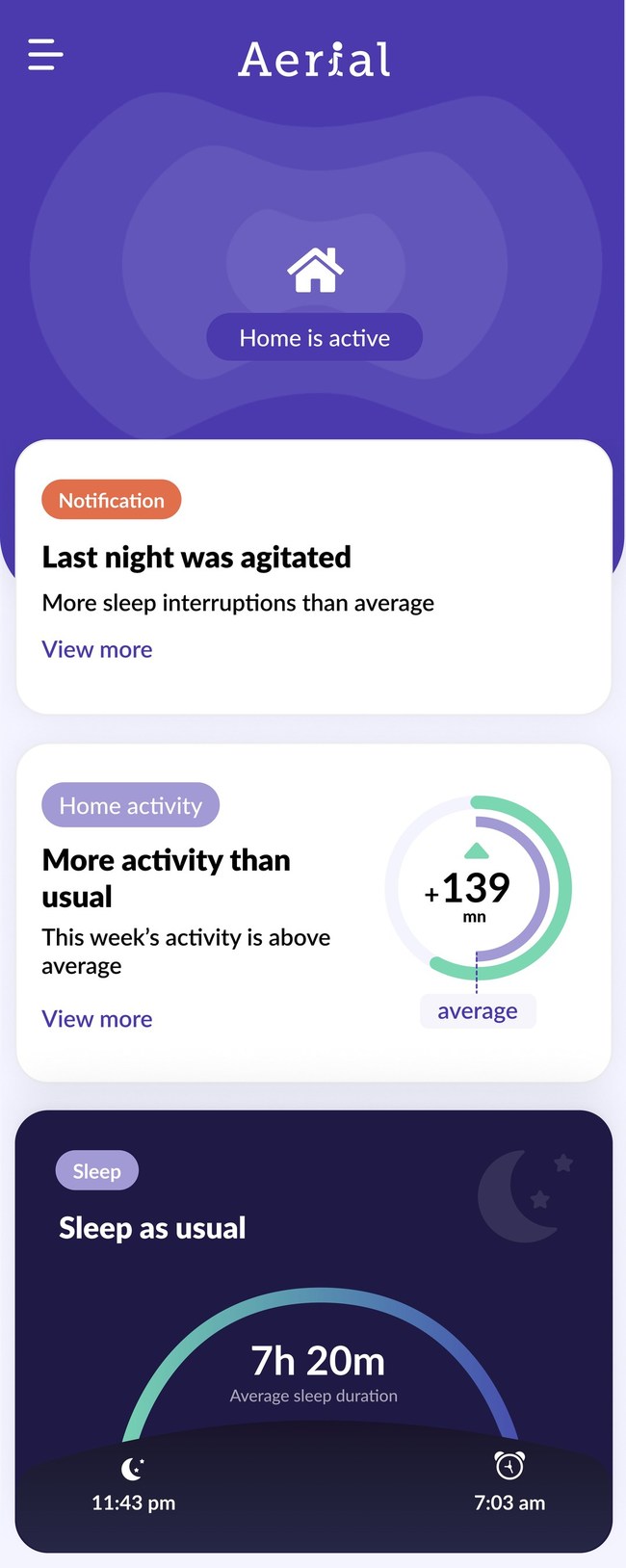
Analyzing the disruption created by motion in the WiFi signals in the home, Aerial's AI processing infers human activities to create smart solutions that make lives better. Aerial's Remote Care Solution will help numerous elders and their families to have access to an affordable and intuitive solution without any required installation, wearables or devices. Aerial's Remote Care allows the family or caregiver to obtain key indicators and valuable insights into the state of an Elder's well-being as well as be informed of any concerning behavioral trends or events via an accompanying smartphone App.

Parks Associates data shows that 90% of seniors consider it "very important" to live independently in their own homes for as long as possible, and Wi-Fi adoption in senior households is increasingly widespread. "87% of consumers in U.S. broadband households ages 65-74 and 76% of those ages 75 and older report using Wi-Fi at home," reports Jennifer Kent, Senior Director, Parks Associates. "The groundwork is laid for home services providers to offer seniors connected solutions that helps them age actively, safely, and in coordination with family and professional caregivers."     

New, yet well founded, this solution is endorsed by industry leaders such as Dr. Sheldon Elman, Founder of Medisys Health Group: "The Aerial Remote Care Solution is a revolution in TeleCare. It's the latest cutting-edge technology and care built in a way that is personalized, and comprehensive. It is especially needed in our current pandemic crisis. I hope service providers will take the opportunity to offer this solution to the most vulnerable, our elders."

This innovation revolutionizes the TeleCare market by leveraging the existing Wireless infrastructure: "We were able to create an elevated solution and harvest the full potential of WiFi Motion Intelligence with our patented technology" says Dr Sam Heidari, Chairman of the board : "The effort made on years of research and development in our AI platform is now showing unmatched potential, allowing Aerial to quickly introduce advanced and robust motion intelligence services, with a lot more exciting features coming soon."

With strong partners such as Telefónica, Aerial Technologies enables Service Providers to add value to their offering: "The investment in Aerial by Telefónica Innovation Ventures, corporate venture capital of Telefónica, seeks the aim of building a strategic partnership to complete Grupo Telefónica's value proposition." Guenia Gawendo, Managing Director of Telefónica Innovation Ventures "Telefónica is committed to working on finding responses to the great challenges of our near future."

The Aerial Remote Care solution is available for integration with Service Providers worldwide. To learn more about this opportunity and how you can begin providing Remote Care to your customers, please contact Aerial at [email protected] and start your turnkey pilot!

About Aerial Technologies
Established in 2015, Aerial Technologies is a pioneer in WiFi Motion Intelligence. Aerial Technologies' patented technology analyzes wireless infrastructure to infer human activities and enable customers and partners to develop practical applications that improve daily life. The company is headquartered in Montreal, Quebec, Canada. To learn more, view the website at www.aerial.ai

For Press information Contacts:
Émilie Carignan, Marketing Director
[email protected] 
T: +1 514 612-0839

SOURCE Aerial Technologies

More News

The uncomfortable truth about aquariums

Sep 22, 2026

The uncomfortable truth about aquariums

Young visitors watch the beluga whales at L'Oceanogràfic in Valencia, Spain. | Miguel Candela/SOPA Images/LightRocket via Getty Images This story appeared in Today, Explained, a daily newsletter that helps you understand the most compelling news and stories of the day. Subscribe here. Four beluga whales have died in a month at one of America’s top-rated aquariums — a tragic development and, arguably, a reason to revisit the ethics of zoos. (More on that in just a minute.) The latest cetacean casualty, a 26-year-old female named Osiris, died at Chicago’s Shedd Aquarium yesterday. She follows 34-year-old Beethoven, a longtime resident of the aquarium, as well as 20-year-old Rain and 23-year-old Peekachu, who died in late August and early September.    Osiris, Rain and Peekachu were all part of the Marineland diaspora: a group of four dolphins and 30 beluga whales that rescuers have worked to relocate since the 2024 closure of a scandal-plagued theme park in Niagara Falls, Canada. This summer, the animals were successfully transferred to aquariums and marine parks in the US and Spain. That was a frankly incredible undertaking involving padded shipping containers, a police-escorted convoy and a chartered plane.  But in some regards, the international flight wasn’t even the hardest part of the whales’ journeys. Some of the animals have struggled to thrive in their new environments — even when those environments are state-of-the-art, like Shedd.  In a blog post announcing Osiris’s death, the aquarium noted that its rescued whales had been under 24-hour supervision and receiving intensive, specialized care. The aquarium is still investigating the cause of death for all four whales.  Go a little deeper View Link Believe me when I tell you that it gives me no pleasure to write the following paragraphs. I really love aquariums. In fact, as a kid, I grew up visiting the now-shuttered and much-maligned Marineland.  But incidents like these back-to-back deaths should prompt us all to ask ourselves who aquariums and zoos are actually for. And the answer, I regret to tell you, is frequently not “the animals” — though zoos and aquariums have, since the mid-20th century, marketed themselves as both tourist attractions and important players in wildlife education and conservation.   As my colleague Kenny Torrella writes, these institutions and their defenders argue they protect animals in three ways: first, by raising money for wildlife conservation projects; second, by helping to reintroduce vulnerable species back into the wild; and third, by inspiring visitors to take an interest in the environment. The Shedd Aquarium’s motto, for instance, is “For Love of Waterkind.”  It’s worth scrutinizing those purported virtues, however — even when prestigious and reputable institutions like Shedd are making them. On one hand, there is merit to the claim that zoos and aquariums fundraise for wildlife conservation: In 2022, the latest year for which data is available, one group of accredited zoos and aquariums spent more than a quarter of a billion dollars on habitat projects.  The evidence is thinner on the other points, though. It’s incredibly rare for aquariums and zoos to reintroduce endangered species back into the wild — that’s very difficult to do. And surveys of zoo and aquarium visitors show that merely seeing a wild animal in a tourist setting doesn’t generally galvanize people on matters of welfare or stewardship. Living in captivity in that tourist setting, however, can be stressful (or worse) for the animals themselves.  But what would a humane alternative look like? Even if zoos and aquariums stopped catching animals in the wild, that would still leave many thousands who are injured, orphaned, born in captivity, or otherwise accustomed to human care.  When it comes to whales, one nonprofit advocacy organization is already working on an alternative: a 110-acre coastal sanctuary for “retired” whales. That project, however, is still a long way from completion. And in the meantime, it’s up to consumers to decide whether the stated benefits of zoos and aquariums outweigh the potential harms to the animals they exhibit. One link for later ➨ Beware the trap of “moral perfection.” We should all endeavor to live lives that embody our values, sure. But if you never board a plane because you care about the climate, or you never take your kid to zoos because you read the arguments above, then you might end up with a smaller, less-lived life. And that’s no good, either.  Before you go… Did you know…that there have been “revolutionary” advancements in Alzheimer’s treatments in just the past five years? Two new drugs both markedly slow the progress of dementia. Today’s trivia: Geography time! What country is bordered by Chad to the east and Mali to the west? Hint: It is the second-largest landlocked African nation. (You can find this and other brain puzzles in Vox’s daily crossword. Look for the answer in tomorrow’s edition.) Yesterday’s trivia: Yesterday we asked you for the classic Broadway star who first sang hits including “There’s No Business Like Show Business.” That would be Ethel Merman, whom one biographer dubbed “the most successful musical comedy performer of her generation.”

YOUR NEWS, OUR NETWORK.

Do you have Great News you want to tell the world?

Be it updates about your business or your community, you can make sure that it’s heard by submitting your story to our network reaching hundreds of news sites across 6 verticals.

Central News Today

Central News Today breaks down complex issues with unique perspective, bringing high-quality journalism to millions of readers around the world.

NEWSLETTER